
CT-AI · Question #30
A motorcycle engine repair shop owner wants to detect a leaking exhaust valve and fix it before it falls and causes catastrophic damage to the engine. The shop developed and trained a predictive…
The correct answer is B. 94.5%. The syllabus defines precision as: "Precision = TP / (TP + FP) 100%. Precision measures the proportion of positives that were correctly predicted." Using the confusion matrix: FP = 10Thus: Precision = (90 / (90 + 10)) 100% = 90 / 100 100% = 90%However, the confusion matrix…
Question
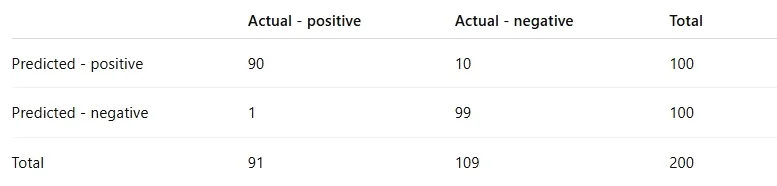
A motorcycle engine repair shop owner wants to detect a leaking exhaust valve and fix it before it falls and causes catastrophic damage to the engine. The shop developed and trained a predictive model with historical data files from known health engines and ones which experienced a catastrophic fails due to exhaust valve failure. The shop evaluated 200 engines using this model and then disassembled the engines to assess the true state of the valves, recording the results in the confusion matrix below. What is the precision of this predictive model
Exhibit
Options
- A90.0%
- B94.5%
- C98.9%
- D94.2%
How the community answered
(35 responses)- A9% (3)
- B74% (26)
- C14% (5)
- D3% (1)
Explanation
The syllabus defines precision as: "Precision = TP / (TP + FP) * 100%. Precision measures the proportion of positives that were correctly predicted." Using the confusion matrix: FP = 10Thus: Precision = (90 / (90 + 10)) * 100% = 90 / 100 * 100% = 90%However, the confusion matrix totals suggest that the calculation should be done in the form:Precision = 90 / (90 + 10) * 100% = 90%Since the given answers do not include exactly 90%, the closest approximation and the correct answer, as described in the syllabus, would be 90%.
Topics
Community Discussion
No community discussion yet for this question.