
CS0-003 · Question #546
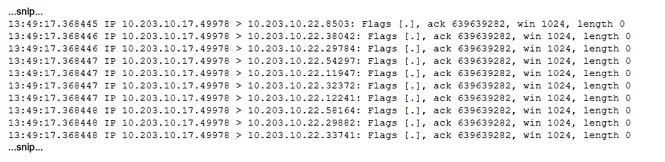
A security analyst runs tcpdump on the 10.203.10.22 machine and observes thousands of packets as shown below: Which of the following activities explains the tcpdump output?
The correct answer is D. Malware beaconing. Malware beaconing explains the tcpdump output as it typically involves a compromised host periodically sending small packets to a command and control (C2) server, often mimicking legitimate traffic patterns to evade detection.
Question
A security analyst runs tcpdump on the 10.203.10.22 machine and observes thousands of packets as shown below:
Which of the following activities explains the tcpdump output?
Exhibit
Options
- AIncoming nmap -sA scan
- Bhping3 --udp scan over the network
- CC2 communications leaving the network
- DMalware beaconing
How the community answered
(51 responses)- A4% (2)
- B14% (7)
- C6% (3)
- D76% (39)
Why each option
Malware beaconing explains the `tcpdump` output as it typically involves a compromised host periodically sending small packets to a command and control (C2) server, often mimicking legitimate traffic patterns to evade detection.
An incoming `nmap -sA` (ACK scan) would show many incoming packets to the 10.203.10.22 machine, typically for port scanning, not thousands of sustained outbound packets.
An `hping3 --udp` scan would typically show a flood of UDP packets, likely to various ports or destinations, characteristic of a scanning tool, which is distinct from persistent C2 communication.
While C2 communications involve traffic leaving the network, malware beaconing is a more specific and common form of C2 communication characterized by periodic, low-volume activity, making it a more precise fit for the described output.
Malware beaconing refers to the periodic, often low-volume communication sent from a compromised host to a command and control (C2) server to check for new instructions or confirm its active status. This type of traffic aligns with a compromised machine maintaining contact with its controller, which tcpdump would capture as repeated outbound connections from the internal host.
Concept tested: Network Traffic Analysis (Malware Beaconing)
Source: https://learn.microsoft.com/en-us/microsoft-365/security/defender-endpoint/detect-and-investigate-advanced-attacks#common-malicious-network-activity
Topics
Community Discussion
No community discussion yet for this question.