
CS0-003 · Question #242
Hotspot Question A security analyst performs various types of vulnerability scans. You must review the vulnerability scan results to determine the type of scan that was executed and determine if a…
The correct answer is Results Generated: Credentialed; Results Generated: Credentialed; Results Generated: Compliance. This hotspot question tests a security analyst's ability to differentiate between credentialed, non-credentialed, and compliance vulnerability scans, identify false positives in scan results, and correctly classify server types based on observed scan findings.
Question
Exhibit
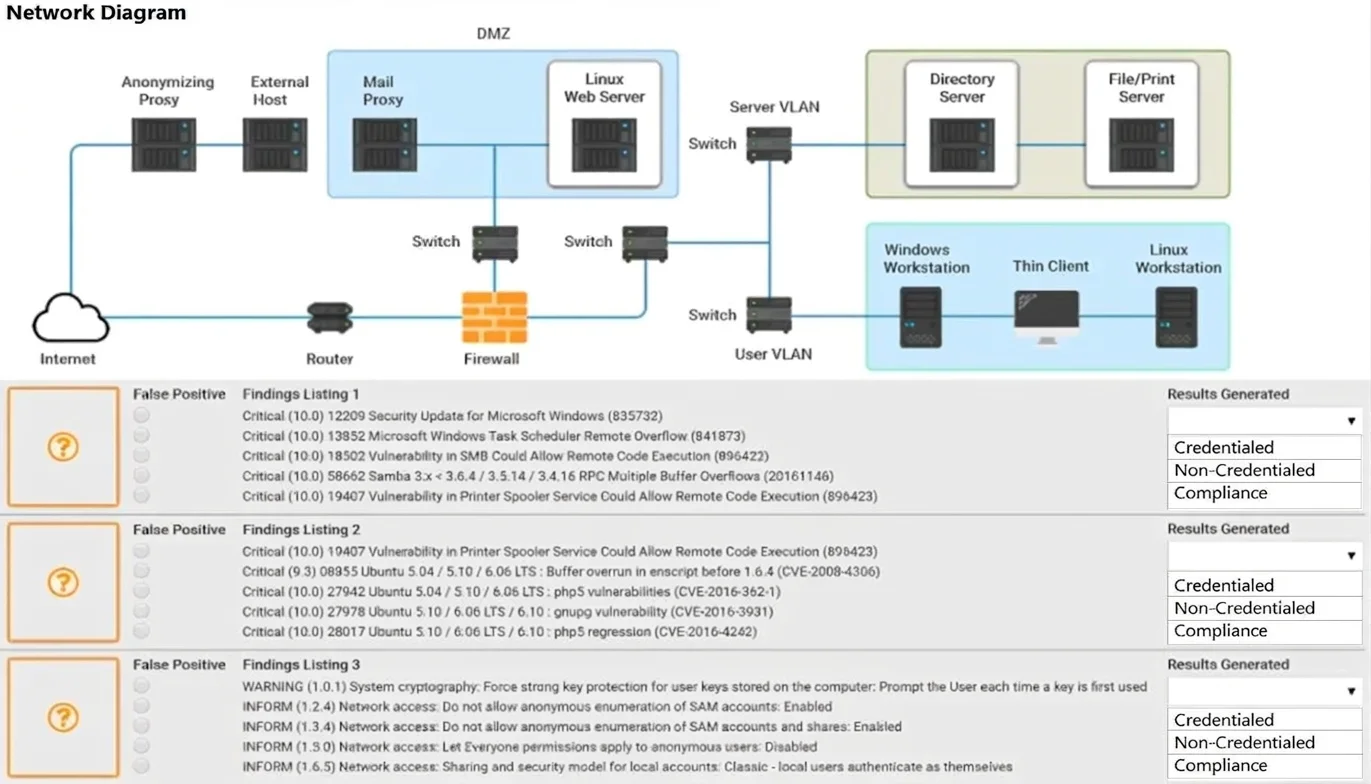
Answer Area
- Results GeneratedCredentialedCredentialedNon-CredentialedCompliance
- Results GeneratedCredentialedCredentialedNon-CredentialedCompliance
- Results GeneratedComplianceCredentialedNon-CredentialedCompliance
Explanation
This hotspot question tests a security analyst's ability to differentiate between credentialed, non-credentialed, and compliance vulnerability scans, identify false positives in scan results, and correctly classify server types based on observed scan findings.
Approach. A credentialed scan uses valid authentication credentials to log into the target system, providing deeper visibility into installed software, patch levels, and configurations - it reveals more vulnerabilities and fewer false positives than a non-credentialed scan. A non-credentialed scan probes the system externally without authentication, simulating an outside attacker's view; it tends to produce more false positives because it infers vulnerability status rather than directly confirming it. A compliance scan checks systems against specific regulatory or policy benchmarks (e.g., PCI-DSS, CIS, STIG) rather than enumerating vulnerabilities. False positives in non-credentialed scans often appear when a service version is flagged as vulnerable but the system has actually been patched without a version change; in credentialed scans, false positives can occur if the scanner misinterprets a registry entry or config file. Server type identification relies on clues in the scan results: open ports and services such as HTTP/HTTPS (80/443) indicate a Linux Web Server, SMB/printing ports (445, 139, 631) indicate a File-Print Server, and LDAP/Kerberos ports (389, 636, 88) indicate a Directory Server.
Concept tested. Vulnerability scan types (credentialed vs. non-credentialed vs. compliance), false positive identification in scan results, and server role classification based on open ports and services discovered during scanning.
Reference. CompTIA Security+ SY0-701 Objective 4.3 – Given a scenario, apply the appropriate vulnerability scanning technique; NIST SP 800-115 Technical Guide to Information Security Testing and Assessment
Topics
Community Discussion
No community discussion yet for this question.