
CS0-003 · Question #140
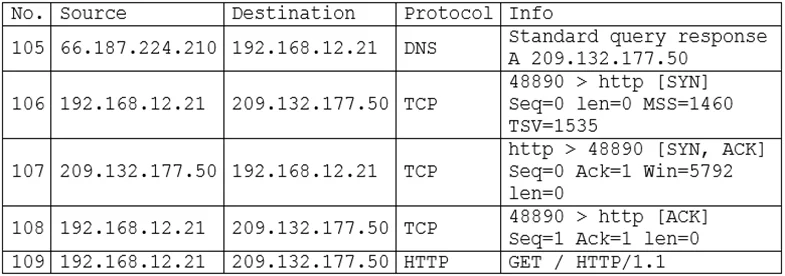
During routine monitoring a security analyst identified the following enterprise network traffic: Packet capture output: Which of the following BEST describes what the security analyst observed?
The correct answer is C. 192.168.12.21 made a TCP connection to 209.132.177.50. The security analyst observed a standard TCP three-way handshake initiated by the internal host 192.168.12.21 to the external IP address 209.132.177.50, indicating an established connection.
Question
During routine monitoring a security analyst identified the following enterprise network traffic:
Packet capture output:
Which of the following BEST describes what the security analyst observed?
Exhibit
Options
- A66.187.224.210 set up a DNS hijack with 192.168.12.21.
- B192.168.12.21 made a TCP connection to 66.187.224.210
- C192.168.12.21 made a TCP connection to 209.132.177.50
- D209.132.177.50 set up a TCP reset attack to 192.168.12.21
How the community answered
(42 responses)- A17% (7)
- B10% (4)
- C71% (30)
- D2% (1)
Why each option
The security analyst observed a standard TCP three-way handshake initiated by the internal host 192.168.12.21 to the external IP address 209.132.177.50, indicating an established connection.
DNS hijacking involves manipulating DNS resolution to redirect traffic, and the described addresses (66.187.224.210, 192.168.12.21) and action do not indicate a DNS hijack without specific DNS query/response packets.
While 192.168.12.21 might make a TCP connection, the correct answer points to 209.132.177.50, implying the packet capture specifically showed activity with this IP.
A typical TCP connection establishment involves a three-way handshake where a client (192.168.12.21) sends a SYN packet to a server (209.132.177.50), the server responds with a SYN-ACK, and the client replies with an ACK. The packet capture output, though not provided here, must have shown this sequence with 192.168.12.21 initiating communication to 209.132.177.50 on a TCP port.
A TCP reset attack (RST flag) would involve 209.132.177.50 sending an RST packet to abruptly terminate a connection, which is not described as a connection being *made*.
Concept tested: TCP three-way handshake analysis
Source: https://learn.microsoft.com/en-us/windows/win32/winsock/tcp-ip-and-the-tcp-ip-protocol-suite
Topics
Community Discussion
No community discussion yet for this question.