
CISSP · Question #1524
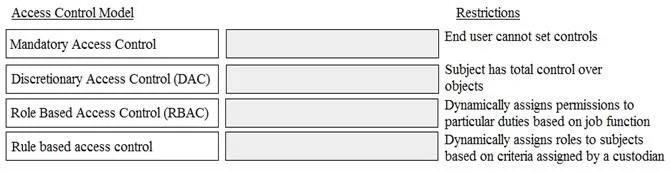
Drag and Drop Question Match the name of access control model with its associated restriction. Drag each access control model to its appropriate restriction access on the right. Answer:
The correct answer is Mandatory Access Control; Discretionary Access Control (DAC); Role Based Access Control (RBAC); Rule based access control. Each access control model has a distinct restriction mechanism: Mandatory Access Control (MAC) restricts access based on security labels and classifications assigned by a central authority (e.g., Top Secret, Secret). Discretionary Access Control (DAC) allows the resource owner…
Question
Drag and Drop Question Match the name of access control model with its associated restriction. Drag each access control model to its appropriate restriction access on the right. Answer:
Exhibit
Answer Area
Drag items
Correct arrangement
- Mandatory Access Control
- Discretionary Access Control (DAC)
- Role Based Access Control (RBAC)
- Rule based access control
Explanation
Each access control model has a distinct restriction mechanism: Mandatory Access Control (MAC) restricts access based on security labels and classifications assigned by a central authority (e.g., Top Secret, Secret). Discretionary Access Control (DAC) allows the resource owner to determine who can access their resources at their discretion. Role Based Access Control (RBAC) grants access based on a user's assigned role within an organization (e.g., Admin, Manager). Rule Based Access Control uses predefined rules or conditions (e.g., time-of-day, IP address rules) to govern access, often used in firewalls and network devices.
Topics
Community Discussion
No community discussion yet for this question.