
CISSP-ISSMP · Question #220
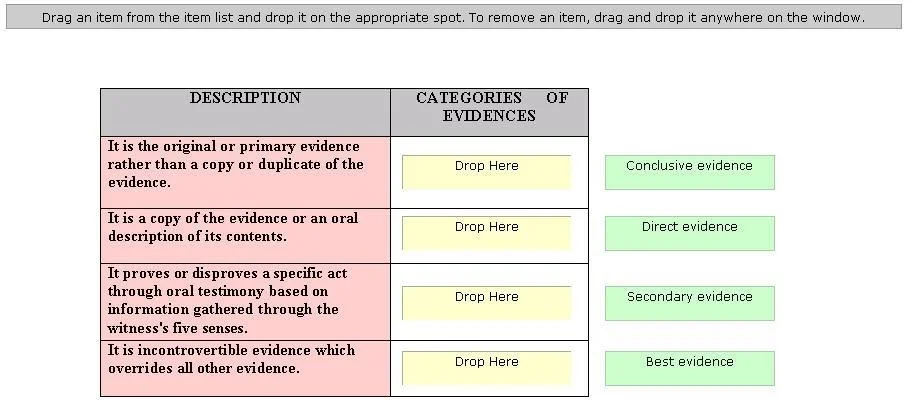
Drag and drop the various evidences in the appropriate places. Answer:
The correct answer is Best evidence; Secondary evidence; Direct evidence; Conclusive evidence. This question tests the understanding of fundamental categories of evidence in legal and forensic contexts by requiring the test-taker to match definitions to their correct evidence classifications.
Question
Exhibit
Answer Area
Drag items
Correct arrangement
- Best evidence
- Secondary evidence
- Direct evidence
- Conclusive evidence
Explanation
This question tests the understanding of fundamental categories of evidence in legal and forensic contexts by requiring the test-taker to match definitions to their correct evidence classifications.
Approach. The correct interaction involves dragging each evidence category from the right list and dropping it onto the 'Drop Here' target next to its accurate description. - 'It is the original or primary evidence rather than a copy or duplicate of the evidence.' should be matched with 'Best evidence' because best evidence refers to the most authentic and original form of evidence. - 'It is a copy of the evidence or an oral description of its contents.' should be matched with 'Secondary evidence' as secondary evidence is a duplicate or testimony about the original's contents, not the original itself. - 'It proves or disproves a specific act through oral testimony based on information gathered through the witness's five senses.' should be matched with 'Direct evidence' because direct evidence typically comes from a witness's direct observation of a fact or event. - 'It is incontrovertible evidence which overrides all other evidence.' should be matched with 'Conclusive evidence' because conclusive evidence is so strong that it cannot be refuted and establishes a fact definitively.
Common mistakes.
- common_mistake. A common mistake is confusing 'Best evidence' with 'Conclusive evidence'. While both imply high reliability, 'Best evidence' specifically refers to the original form of evidence, whereas 'Conclusive evidence' refers to evidence that is indisputable and overrides all others, regardless of its original or copy status. Another mistake is misinterpreting 'Secondary evidence' and 'Direct evidence'. Secondary evidence is about the form of the evidence (a copy or description of contents), while direct evidence is about the source (direct observation or testimony of the fact itself). Incorrectly matching a description to a category demonstrates a lack of precise understanding of forensic and legal evidence terminology.
Concept tested. The underlying technical concept being tested is the classification and understanding of different types of evidence within digital forensics and legal frameworks, including Best, Secondary, Direct, and Conclusive evidence.
Topics
Community Discussion
No community discussion yet for this question.