
CERTIFIED-DATA-ENGINEER-PROFESSIONAL · Question #65
A member of the data engineering team has submitted a short notebook that they wish to schedule as part of a larger data pipeline. Assume that the commands provided below produce the logically…
The correct answer is E. Cmd 6. When scheduling a Databricks notebook as a job, it's generally recommended to remove or modify commands that involve displaying output, such as using the display() function. Displaying data using display() is an interactive feature designed for exploration and visualization…
Question
A member of the data engineering team has submitted a short notebook that they wish to schedule as part of a larger data pipeline. Assume that the commands provided below produce the logically correct results when run as presented. Which command should be removed from the notebook before scheduling it as a job?
Exhibit
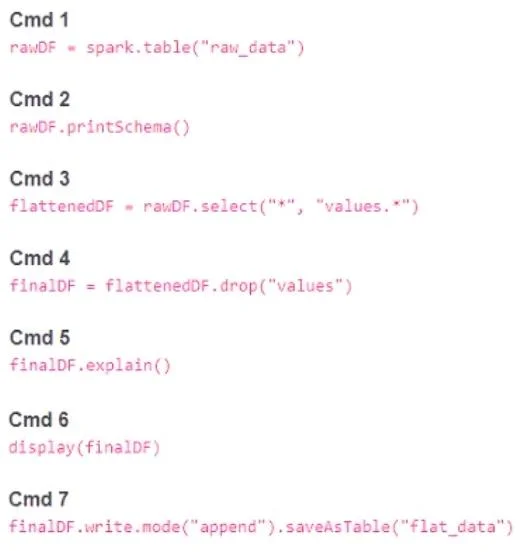
Options
- ACmd 2
- BCmd 3
- CCmd 4
- DCmd 5
- ECmd 6
How the community answered
(16 responses)- D6% (1)
- E94% (15)
Explanation
When scheduling a Databricks notebook as a job, it's generally recommended to remove or modify commands that involve displaying output, such as using the display() function. Displaying data using display() is an interactive feature designed for exploration and visualization within the notebook interface and may not work well in a production job context. The finalDF.explain() command, which provides the execution plan of the DataFrame transformations and actions, is often useful for debugging and optimizing queries. While it doesn't display interactive visualizations like display(), it can still be informative for understanding how Spark is executing the operations on your DataFrame.
Topics
Community Discussion
No community discussion yet for this question.