
CERTIFIED-DATA-ENGINEER-PROFESSIONAL · Question #52
Review the following error traceback: Which statement describes the error being raised?
The correct answer is B. There is no column in the table named heartrateheartrateheartrate. Although the actual traceback image is not visible, the correct answer reveals the nature of the error: a column named 'heartrateheartrateheartrate' does not exist. This type of error typically arises from an AnalysisException in Spark when a column reference cannot be…
Question
Review the following error traceback:
Which statement describes the error being raised?
Exhibit
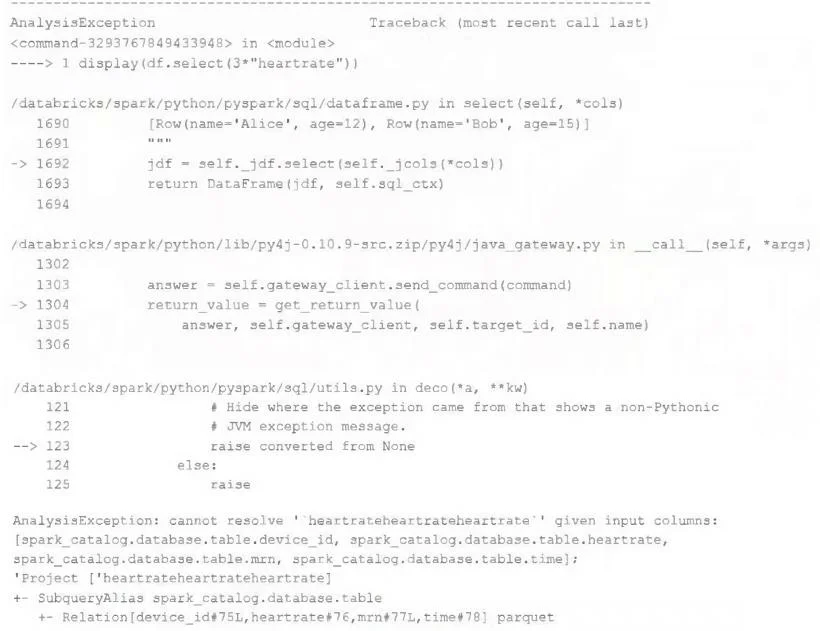
Options
- AThe code executed was PvSoark but was executed in a Scala notebook.
- BThere is no column in the table named heartrateheartrateheartrate
- CThere is a type error because a column object cannot be multiplied.
- DThere is a type error because a DataFrame object cannot be multiplied.
- EThere is a syntax error because the heartrate column is not correctly identified as a column.
How the community answered
(28 responses)- A7% (2)
- B89% (25)
- D4% (1)
Explanation
Although the actual traceback image is not visible, the correct answer reveals the nature of the error: a column named 'heartrateheartrateheartrate' does not exist. This type of error typically arises from an AnalysisException in Spark when a column reference cannot be resolved. The tripled name ('heartrate' repeated three times concatenated) strongly suggests a programmer mistakenly concatenated string column names instead of performing arithmetic multiplication - for example, writing col('heartrate') * 'heartrate' * 'heartrate' or similar logic that resolved to the string 'heartrateheartrateheartrate' as a column lookup. This is an AnalysisException (a column resolution error), not a TypeError about DataFrames or Column objects, ruling out options C and D. It is also not a Python syntax error nor a language mismatch.
Topics
Community Discussion
No community discussion yet for this question.