
CERTIFIED-DATA-ENGINEER-PROFESSIONAL · Question #40
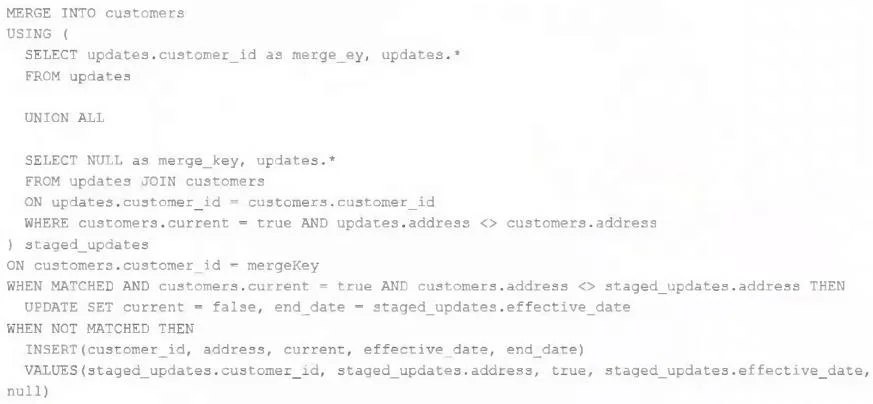
The view updates represents an incremental batch of all newly ingested data to be inserted or updated in the customers table. The following logic is used to process these records. Which statement…
The correct answer is B. The customers table is implemented as a Type 2 table; old values are maintained but marked as. Slowly Changing Dimension (SCD) Type 2 maintains a full history of changes by inserting new rows for updated records while marking old rows as inactive (typically via an is_current boolean flag or effective date range columns). The MERGE logic described inserts new rows for…
Question
The view updates represents an incremental batch of all newly ingested data to be inserted or updated in the customers table. The following logic is used to process these records. Which statement describes this implementation?
Exhibit
Options
- AThe customers table is implemented as a Type 3 table; old values are maintained as a new
- BThe customers table is implemented as a Type 2 table; old values are maintained but marked as
- CThe customers table is implemented as a Type 0 table; all writes are append only with no
- DThe customers table is implemented as a Type 1 table; old values are overwritten by new values
- EThe customers table is implemented as a Type 2 table; old values are overwritten and new
How the community answered
(31 responses)- A3% (1)
- B90% (28)
- D3% (1)
- E3% (1)
Explanation
Slowly Changing Dimension (SCD) Type 2 maintains a full history of changes by inserting new rows for updated records while marking old rows as inactive (typically via an is_current boolean flag or effective date range columns). The MERGE logic described inserts new rows for updated customers and sets a flag on the old row rather than overwriting it - this is the hallmark of SCD Type 2. Type 1 overwrites old values (no history). Type 0 is append-only with no updates. Type 3 stores only the current and one previous value in the same row. Option E is incorrect because it says 'old values are overwritten,' which contradicts Type 2 behavior. Only option B correctly states that old values are maintained but marked as inactive.
Topics
Community Discussion
No community discussion yet for this question.