
CERTIFIED-DATA-ENGINEER-PROFESSIONAL · Question #12
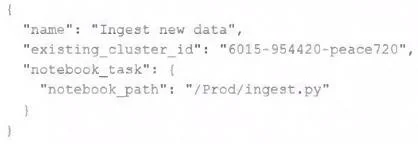
A junior data engineer has configured a workload that posts the following JSON to the Databricks REST API endpoint 2.0/jobs/create. Assuming that all configurations and referenced resources are…
The correct answer is C. Three new jobs named "Ingest new data" will be defined in the workspace, but no jobs will be. The Databricks REST API endpoint 2.0/jobs/create is used to define (register) a new job in the workspace - it does NOT trigger or run the job. Each call to this endpoint creates a separate, independent job definition. Calling it three times produces three distinct job entries…
Question
A junior data engineer has configured a workload that posts the following JSON to the Databricks REST API endpoint 2.0/jobs/create. Assuming that all configurations and referenced resources are available, which statement describes the result of executing this workload three times?
Exhibit
Options
- AThree new jobs named "Ingest new data" will be defined in the workspace, and they will each run
- BThe logic defined in the referenced notebook will be executed three times on new clusters with
- CThree new jobs named "Ingest new data" will be defined in the workspace, but no jobs will be
- DOne new job named "Ingest new data" will be defined in the workspace, but it will not be
- EThe logic defined in the referenced notebook will be executed three times on the referenced
How the community answered
(21 responses)- A5% (1)
- C90% (19)
- D5% (1)
Explanation
The Databricks REST API endpoint 2.0/jobs/create is used to define (register) a new job in the workspace - it does NOT trigger or run the job. Each call to this endpoint creates a separate, independent job definition. Calling it three times produces three distinct job entries named 'Ingest new data', each with its own job ID. To actually execute a job, a separate call to 2.0/jobs/run-now (or equivalent) is required. Since the workload only calls jobs/create, no executions occur - only three job definitions are created.
Topics
Community Discussion
No community discussion yet for this question.