
CCDAK · Question #220
Drag and Drop Question You are creating a Kafka streams application to process data for retail stores. Match the input data streams with the appropriate Kafka streams object. To answer, move each of…
The correct answer is Customers; Orders_Placed. Kafka Streams: Matching Data Streams to Objects Note: The question as provided is incomplete - it shows 4 items but only 2 correct answers, and doesn't specify the target Kafka Streams objects (KStream vs KTable). Based on standard Kafka Streams exam questions for retail…
Question
Drag and Drop Question You are creating a Kafka streams application to process data for retail stores. Match the input data streams with the appropriate Kafka streams object. To answer, move each of the options below to the corresponding answer area. Partial credit is given for each correct answer. Answer:
Exam Questions, Study Guides, Practice Tests. Lead the way to help you pass any IT Certification exams, 100% Pass Guaranteed or Full Refund. Especially Cisco, Microsoft, CompTIA, Citrix, EMC, HP, Oracle, VMware, Juniper, Check Point, LPI, Nortel, EXIN and so on. Our Slogan: First Test, First Pass. Help you to pass any IT Certification exams at the first try. You can reach us at any of the email addresses listed below. Any problems about IT certification or our products, you could rely upon us, we will give you satisfactory answers in 24 hours.
Exhibit
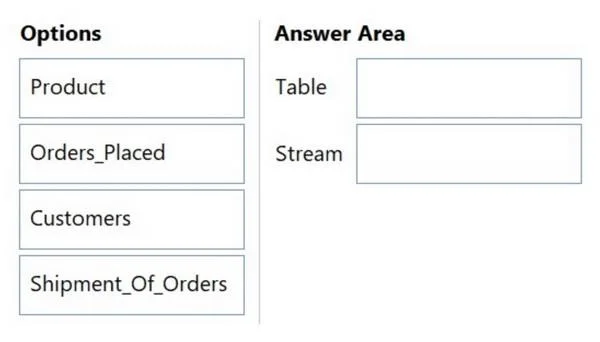
Answer Area
Drag items
Correct arrangement
- Customers
- Orders_Placed
Explanation
Kafka Streams: Matching Data Streams to Objects
Note: The question as provided is incomplete - it shows 4 items but only 2 correct answers, and doesn't specify the target Kafka Streams objects (KStream vs KTable). Based on standard Kafka Streams exam questions for retail scenarios, the typical mapping is:
Core Concepts First
| Object | What it represents |
|---|---|
| KStream | Unbounded sequence of events - every record is new/independent |
| KTable | A changelog/state table - records are updates to a keyed state |
Item Placements
Customers → KTable
Customer records represent reference/lookup data. A customer record (by customer ID) is updated in place - address changes, name changes. Each new record replaces the previous value for that key. This is the definition of a KTable.
Orders_Placed → KStream
Each order is an independent event. Order #101 and Order #102 are separate records, not updates to the same key. This append-only event stream maps to KStream.
Product → KTable
Product catalog data (price, name, description) is reference data keyed by product ID. Updates replace previous values - KTable.
Shipment_Of_Orders → KStream
Shipments are discrete events triggered per order. Like orders, each shipment is a new independent fact - KStream.
Common Mistakes
- Treating all retail data as KStream - Events (orders, shipments) are KStreams; reference/lookup data (customers, products) are KTables.
- Confusing KTable with a database table - A KTable is built from a KStream; it materializes the latest value per key.
- Missing GlobalKTable - In joins,
CustomersandProductare sometimesGlobalKTable(replicated to all partitions) for efficiency, not justKTable.
Topics
Community Discussion
No community discussion yet for this question.