
CCA-410 · Question #6
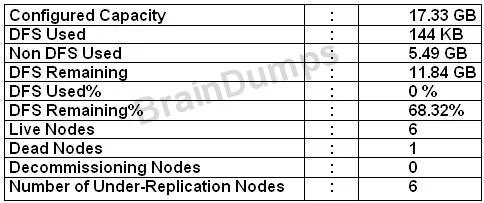
Cluster Summary 45 files and directories, 12 blocks = 57 total. Heap Size is 15.31 MB / 193.38MB(7%) Refer to the above screenshot. You configure the Hadoop cluster with seven DataNodes and the…
The correct answer is A. The HDFS cluster is in the safe mode. The data from the dead node is being replicated. The cluster is in safemode. During start up Namenode loads the filesystem state from fsimage and edits log file. It then waits for datanodes to report their blocks so that it does not prematurely start replicating the blocks…
Question
Cluster Summary 45 files and directories, 12 blocks = 57 total. Heap Size is 15.31 MB / 193.38MB(7%) Refer to the above screenshot. You configure the Hadoop cluster with seven DataNodes and the NameNode's web UI displays the details shown in the exhibit. What does this tells you?
Exhibit
Options
- AThe HDFS cluster is in the safe mode.
- BYour cluster has lost all HDFS data which had blocks stored on the dead DataNode.
- COne physical host crashed.
- DThe DataNode JVM on one host is not active.
How the community answered
(23 responses)- A78% (18)
- B4% (1)
- C4% (1)
- D13% (3)
Explanation
The data from the dead node is being replicated. The cluster is in safemode. During start up Namenode loads the filesystem state from fsimage and edits log file. It then waits for datanodes to report their blocks so that it does not prematurely start replicating the blocks though enough replicas already exist in the cluster. During this time Namenode stays in safemode. A Safemode for Namenode is essentially a read-only mode for the HDFS cluster, where it does not allow any modifications to filesystem or blocks. Normally Namenode gets out of safemode automatically at the beginning. If required, HDFS could be placed in safemode explicitly using 'bin/hadoop dfsadmin -safemode' command. Namenode front page shows whether safemode is on or off. A more detailed description and configuration is maintained as JavaDoc for setSafeMode(). * Data Disk Failure, Heartbeats and Re-Replication Each DataNode sends a Heartbeat message to the NameNode periodically. A network partition can cause a subset of DataNodes to lose connectivity with the NameNode. The NameNode detects this condition by the absence of a Heartbeat message. The NameNode marks DataNodes without recent Heartbeats as dead and does not forward any new IO requests to them. Any data that was registered to a dead DataNode is not available to HDFS any more. DataNode death may cause the replication factor of some blocks to fall below their specified value. The NameNode constantly tracks which blocks need to be replicated and initiates replication whenever necessary. The necessity for re-replication may arise due to many reasons: a DataNode may become unavailable, a replica may become corrupted, a hard disk on a DataNode may fail, or the replication factor of a file may be increased. * NameNode periodically receives a Heartbeat and a Blockreport from each of the DataNodes in the cluster. Receipt of a Heartbeat implies that the DataNode is functioning properly. A Blockreport contains a list of all blocks on a DataNode. When NameNode notices that it has not recieved a hearbeat message from a data node after a certain amount of time, the data node is marked as dead. Since blocks will be under replicated the system begins replicating the blocks that were stored on the dead datanode. The NameNode Orchestrates the replication of data blocks from one datanode to another. The replication data transfer happens directly between datanodes and the data never passes through the namenode. Incorrrect answers: B: The data is not lost, it is being replicated. NameNode Handles data node failures?
Topics
Community Discussion
No community discussion yet for this question.