
C9530-001 · Question #130
Two different sets of applications are deployed to Integration Server 1 and Integration Server 2 respectively, as shown in the image below. What is the advantage of using the Integration Server…
The correct answer is B. Load balancing. Each connector has its own assigned port, which is allocated from a range of numbers, as required. The default range for the HTTPConnector is 7800 - 7842; the default range for the HTTPSConnector is 7843 - 7884. The first integration server to start an embedded listener is…
Question
Two different sets of applications are deployed to Integration Server 1 and Integration Server 2 respectively, as shown in the image below. What is the advantage of using the Integration Server embedded HTTP listener to the Integration Node listener?
Exhibit
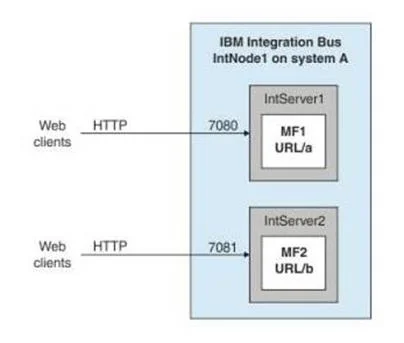
Options
- AFailover
- BLoad balancing
- CBetter throughput
- DSingle IP address for HTTP clients to use
How the community answered
(24 responses)- A4% (1)
- B79% (19)
- C4% (1)
- D13% (3)
Explanation
Each connector has its own assigned port, which is allocated from a range of numbers, as required. The default range for the HTTPConnector is 7800 - 7842; the default range for the HTTPSConnector is 7843 - 7884. The first integration server to start an embedded listener is allocated port 7800, the second is allocated 7801, and so on. If you deploy a message flow to multiple integration servers, the port number is incremented by one for each successive deployment. Assume that no embedded listeners have as yet been started for these integration servers. In this case, the message flow that is deployed to the first integration server receives requests on port 7800. The next message flow uses port 7801, and so on, up to the specified limit of 7842. In this scenario, you typically use an intermediary router that listens on one port, then distributes the requests across the range of ports that you are using.
Topics
Community Discussion
No community discussion yet for this question.