
AZ-900 · Question #521
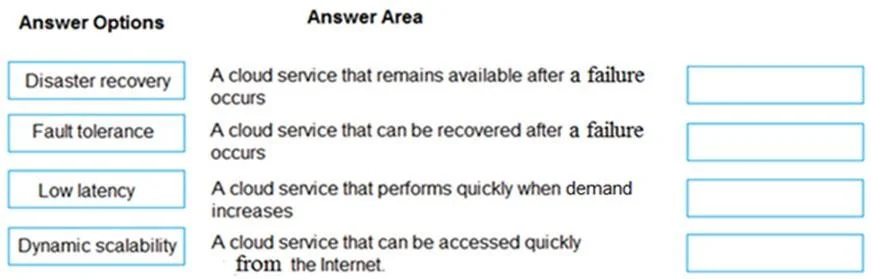
Drag and Drop Question Match the Azure services benefits to the correct descriptions. Instructions: To answer, drag the appropriate benefit from the column on the left to its description on the…
The correct answer is Fault tolerance; Disaster recovery; Dynamic scalability; Low latency. The correct arrangement maps each benefit to its core definition: Fault tolerance refers to a system's ability to continue operating despite component failures (e.g., redundant hardware/software). Disaster recovery describes the process of restoring systems and data after a…
Question
Exhibit
Answer Area
Drag items
Correct arrangement
- Fault tolerance
- Disaster recovery
- Dynamic scalability
- Low latency
Explanation
The correct arrangement maps each benefit to its core definition: Fault tolerance refers to a system's ability to continue operating despite component failures (e.g., redundant hardware/software). Disaster recovery describes the process of restoring systems and data after a catastrophic event. Dynamic scalability means resources can be automatically scaled up or down based on demand. Low latency refers to minimal delay in data transmission or processing, ensuring fast response times for users. Each term has a precise technical meaning that distinguishes it from the others.
Topics
Community Discussion
No community discussion yet for this question.