
AZ-900 · Question #307
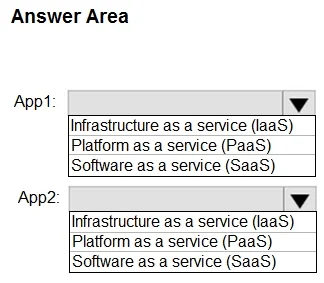
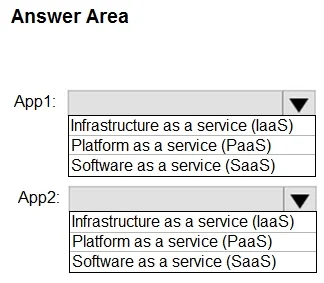
Hotspot Question You plan to use Azure to host two apps named App1 and App2. The apps must meet the following requirements: - You must be able to modify the code of App1 - Administrative effort to…
To meet the requirements, App1 should use Platform as a Service (PaaS) to allow code modification while minimizing OS management, and App2 should use Infrastructure as a Service (IaaS) for direct operating system interaction.
Question
Exhibits
Answer Area
- App1:Infrastructure as a service (IaaS)Platform as a service (PaaS)Software as a service (SaaS)
- App2:Infrastructure as a service (IaaS)Platform as a service (PaaS)Software as a service (SaaS)
Explanation
To meet the requirements, App1 should use Platform as a Service (PaaS) to allow code modification while minimizing OS management, and App2 should use Infrastructure as a Service (IaaS) for direct operating system interaction.
Approach. For App1, the requirements are: 'You must be able to modify the code of App1' and 'Administrative effort to manage the operating system of App1 must be minimized.' Platform as a Service (PaaS) is the ideal choice. PaaS provides a complete development and deployment environment in the cloud, allowing developers to build, run, and manage applications without the complexity of building and maintaining the infrastructure typically associated with developing and launching an app. The cloud provider manages the operating system, runtime, middleware, and underlying infrastructure, thereby minimizing administrative effort for OS management, while still allowing the user to deploy and modify their application code.
For App2, the requirement is: 'App2 must run interactively with the operating system of the server.' This indicates a need for direct control over the operating system environment. Infrastructure as a Service (IaaS) is the correct choice here. IaaS provides virtualized computing resources over the internet. With IaaS, the cloud provider manages the virtualization, servers, storage, and networking, but the user is responsible for managing the operating system, applications, and data. This level of control over the OS is necessary for applications that need to interact directly or 'interactively' with the underlying operating system.
Common mistakes.
- common_mistake. A common mistake would be to misinterpret the level of control or management responsibility required for each app. Selecting Software as a Service (SaaS) for either app would be incorrect because SaaS is a complete, ready-to-use application managed entirely by a third party. Users of SaaS typically cannot modify application code (App1's requirement) or interact directly with the underlying operating system (App2's requirement).
Choosing IaaS for App1 would be wrong because while it allows code modification, it would place the burden of OS management on the user, failing the requirement to minimize administrative effort for the OS. Choosing PaaS for App2 would be incorrect because PaaS abstracts away the operating system, preventing the application from running 'interactively' with it as required.
Concept tested. Understanding of cloud service models (IaaS, PaaS, SaaS) and their respective characteristics, user responsibilities, provider responsibilities, and suitability for different application requirements and scenarios.
Topics
Community Discussion
No community discussion yet for this question.