
AZ-800 · Question #229
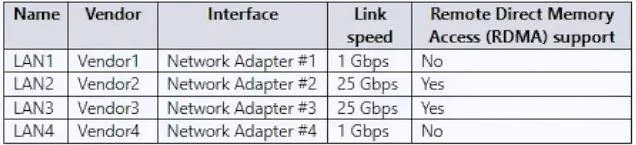
You have a server that runs Windows Server 2022 and has the network adapters shown in the following table. You need to configure NIC teaming for LAN2 and LAN3. The solution must support Dynamic…
The correct answer is B. Switch Embedded Teaming (SET). To support Dynamic Virtual Machine Multi-Queue (d.VMMQ) when configuring NIC teaming for Hyper-V on Windows Server 2022, Switch Embedded Teaming (SET) is the required solution.
Question
You have a server that runs Windows Server 2022 and has the network adapters shown in the following table. You need to configure NIC teaming for LAN2 and LAN3. The solution must support Dynamic Virtual Machine Multi-Queue (d.VMMQ). What should you use?
Exhibit
Options
- ALACP teaming mode
- BSwitch Embedded Teaming (SET)
- Cload balancing and failover (LBFO)
- DStatic teaming mode
How the community answered
(40 responses)- A5% (2)
- B70% (28)
- C15% (6)
- D10% (4)
Why each option
To support Dynamic Virtual Machine Multi-Queue (d.VMMQ) when configuring NIC teaming for Hyper-V on Windows Server 2022, Switch Embedded Teaming (SET) is the required solution.
LACP teaming mode is a general-purpose NIC teaming standard that does not natively support Hyper-V specific features like d.VMMQ.
Switch Embedded Teaming (SET) is a Hyper-V specific NIC teaming solution that is required to support advanced features like Dynamic Virtual Machine Multi-Queue (d.VMMQ). d.VMMQ significantly improves network throughput and performance for virtual machines by distributing incoming traffic across multiple CPU cores.
Load Balancing and Failover (LBFO) is the traditional Windows Server NIC Teaming, which does not support Dynamic Virtual Machine Multi-Queue (d.VMMQ) functionality.
Static teaming mode is a basic NIC teaming configuration that, like LACP and LBFO, does not offer the Hyper-V specific optimizations required for d.VMMQ.
Concept tested: Switch Embedded Teaming (SET) and d.VMMQ
Source: https://learn.microsoft.com/en-us/windows-server/networking/technologies/nic-teaming/set-overview
Topics
Community Discussion
No community discussion yet for this question.