
AZ-500 · Question #9
Case Study 2 - Contoso, Ltd Overview Contoso, Ltd. is a consulting company that has a main office in Montreal and two branch offices in Seattle and New York. The company hosts its entire server…
Important Caveat The question references specific NSG rule tables and VM/subnet assignments that are not included in the text you provided. Without those tables, I cannot give definitive Yes/No answers. However, I can explain exactly how to reason through each statement - this…
Question
Exhibits
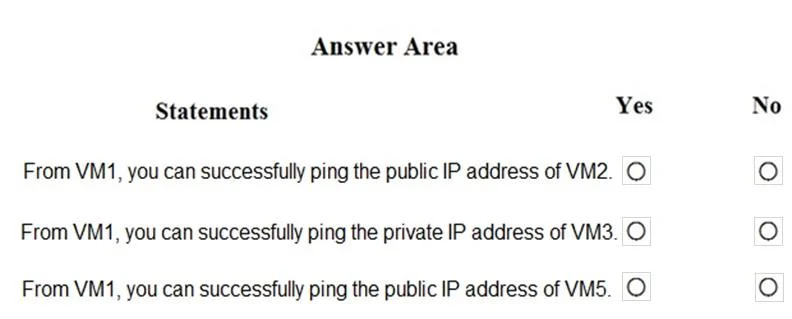
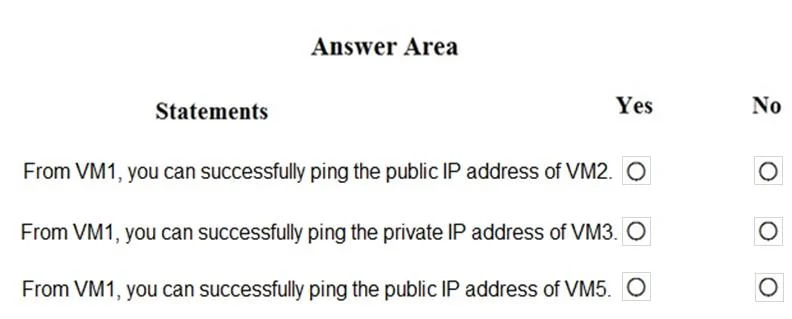
Answer Area
- From VM1, you can successfully ping the public IP address of VM2.
- From VM1, you can successfully ping the private IP address of VM3.
- From VM1, you can successfully ping the public IP address of VM5.
Explanation
Important Caveat
The question references specific NSG rule tables and VM/subnet assignments that are not included in the text you provided. Without those tables, I cannot give definitive Yes/No answers. However, I can explain exactly how to reason through each statement - this is the skill the exam is testing.
Framework for Evaluating NSG-Based Ping Questions
Core Concepts You Must Apply
1. NSG Rule Evaluation
- Rules are processed by priority (lowest number first)
- First matching rule wins - processing stops
- Default rules at the end:
AllowVnetInBound,AllowAzureLoadBalancerInBound,DenyAllInBound - ICMP (ping) must be explicitly permitted - it does not automatically pass just because HTTP/RDP is allowed
2. Public IP vs. Private IP Traffic Path
| Traffic Type | Path |
|---|---|
| VM1 -> VM2 public IP | Leaves VNet -> Internet -> re-enters via VM2's NIC -> hits VM2's NSG inbound rules |
| VM1 -> VM3 private IP | Stays inside VNet -> hits VM3's NSG inbound rules with source tag VirtualNetwork |
This distinction matters because NSG rules filter differently depending on whether traffic is tagged as Internet or VirtualNetwork.
3. OS Firewall vs. NSG The case study states all VM firewalls allow ping. So OS-level blocking is not the issue - focus entirely on NSG rules.
How to Answer Each Statement
Statement 1: VM1 -> ping public IP of VM2
What to check:
- VM2's associated NSG inbound rules
- Look for a rule that allows ICMP (protocol =
ICMPorAny) from sourceInternetor* - If no such rule exists before a
DenyAll, the answer is No
Key concept: Traffic to a public IP is tagged as
Internetsource. Most NSGs in exam scenarios only explicitly allow TCP 80/443/3389 - ICMP is denied by the defaultDenyAllInBoundrule.
Statement 2: VM1 -> ping private IP of VM3
What to check:
- VM3's associated NSG inbound rules
- Look for a rule allowing ICMP from source
VirtualNetworkor the specific subnet/IP of VM1 - The default
AllowVnetInBoundrule does allow all traffic from the VNet tag - but only if no higher-priority rule denies it first
Key concept: If NSG3 has a high-priority
Deny Anyrule for inbound traffic before theAllowVnetInBounddefault, pings from within the same VNet are still blocked.
Statement 3: VM1 -> ping public IP of VM5
What to check:
- VM5's associated NSG (or whether VM5 has an NSG at all)
- If VM5 has no NSG, or its NSG has a rule
Allow ICMP Any, the answer is Yes - Also check if VM5 is on a subnet with a subnet-level NSG
Key concept: No NSG = all traffic flows. A missing or permissive NSG is often the "Yes" scenario in exam questions.
Memory Tips
| Scenario | Remember |
|---|---|
| Public IP ping | Think "Internet source tag" - most NSGs deny ICMP from Internet by default |
| Private IP ping | Think "AllowVnetInBound" - allowed by default unless overridden by a higher-priority Deny rule |
| No NSG on VM | Traffic is unrestricted - always "Yes" for ping |
| OS firewall | The case study explicitly says all VMs allow ping - eliminate this as a factor |
To get the definitive answers, locate the NSG inbound rule tables for NSG2 (applied to VM2), NSG3 (applied to VM3), and whichever NSG applies to VM5 - then trace each ping through the priority-ordered rules looking for an Allow ICMP or Allow Any match before a Deny.
Topics
Community Discussion
No community discussion yet for this question.