
AZ-500 · Question #552
Case Study 4 - Fabrikam, Inc Overview Fabrikam, Inc. is a consulting company. The company has a main office in New York City and branch offices in Amsterdam and Singapore. Existing Environment…
This question tests understanding of Azure Role-Based Access Control (RBAC) by requiring the assignment of appropriate built-in roles to an Azure Kubernetes Service (AKS) identity and another general identity for common Azure resource interactions.
Question
Exhibit
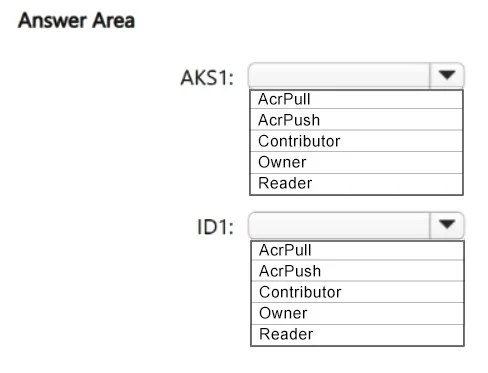
Answer Area
- AKS1:AcrPullAcrPushContributorOwnerReader
- ID1:AcrPullAcrPushContributorOwnerReader
Explanation
This question tests understanding of Azure Role-Based Access Control (RBAC) by requiring the assignment of appropriate built-in roles to an Azure Kubernetes Service (AKS) identity and another general identity for common Azure resource interactions.
Approach. The correct interaction is to select 'AcrPull' for AKS1 and 'Contributor' for ID1.
- For AKS1: Select 'AcrPull'. An Azure Kubernetes Service (AKS) cluster, or its associated service principal/managed identity, typically needs to retrieve (pull) container images from an Azure Container Registry (ACR) to deploy applications. The 'AcrPull' role is specifically designed to grant read access to an Azure Container Registry, allowing the identity to pull images and artifacts. This adheres to the principle of least privilege, providing only the necessary permissions for image retrieval.
- For ID1: Select 'Contributor'. The 'Contributor' role allows an identity (such as a developer or operations engineer represented by ID1) to manage all resources within a given scope (e.g., a resource group or subscription), but it does not allow them to manage access to those resources. This is a common and appropriate role for users who need to create, update, and delete Azure resources without having full administrative control over permissions.
Common mistakes.
- common_mistake. Common mistakes include assigning overly permissive roles, roles that are too restrictive, or roles that are functionally incorrect for the implied task:
- AKS1: AcrPush: This role is for pushing images to an ACR. While an AKS cluster could be involved in CI/CD that pushes images, the primary requirement for deploying applications to AKS is to pull images. Assigning 'AcrPush' when only 'AcrPull' is needed violates the principle of least privilege.
- AKS1: Contributor/Owner/Reader: These are broader management roles. 'Contributor' or 'Owner' on the ACR would grant unnecessary permissions beyond just pulling, while 'Reader' on ACR would not allow pulling images.
- ID1: Owner: This role grants full control, including managing access. While it would provide the necessary permissions, it often provides more access than required for a general identity managing resources, thus violating the principle of least privilege.
- ID1: Reader: This role only allows viewing resources and their settings. It would be insufficient for an identity that needs to 'manage' or create resources.
- ID1: AcrPull/AcrPush: These roles are specific to Azure Container Registry operations and would be inappropriate for a general identity (ID1) that likely needs to manage various types of Azure resources.
Concept tested. Azure Role-Based Access Control (RBAC), principle of least privilege, and understanding of built-in Azure roles (AcrPull, AcrPush, Contributor, Owner, Reader) in the context of Azure services like Azure Kubernetes Service (AKS) and Azure Container Registry (ACR).
Topics
Community Discussion
No community discussion yet for this question.