
AZ-500 · Question #518
Drag and Drop Question You have an Azure subscription that contains the resources shown in the following table. You need to configure network connectivity to meet the following requirements…
The correct answer is VNet1: A service endpoint; NSG1: A route table. A service endpoint on VNet1 enables VM1 to communicate with storage1 over an optimized Microsoft backbone network path rather than through the public internet, satisfying the first requirement at minimal cost compared to a private endpoint. For NSG1, configuring a service tag…
Question
Exhibits
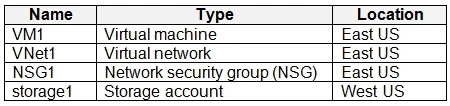
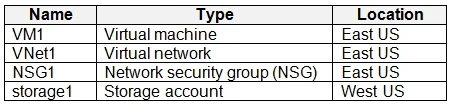
Answer Area
Drag items
Correct arrangement
- VNet1: A service endpoint
- NSG1: A route table
Explanation
A service endpoint on VNet1 enables VM1 to communicate with storage1 over an optimized Microsoft backbone network path rather than through the public internet, satisfying the first requirement at minimal cost compared to a private endpoint. For NSG1, configuring a service tag (specifically the 'Internet' service tag in an outbound deny rule) would block all outbound internet traffic - however, the correct answer here indicates a route table for NSG1, which is used to direct traffic; but more accurately, the intended pairing is: VNet1 gets a service endpoint to route storage traffic over the Microsoft backbone, and NSG1 uses a service tag (like 'Internet') in an outbound deny rule to block all internet-bound traffic from VM1. A service endpoint on VNet1 is the cost-effective solution for private storage connectivity, while the outbound deny rule on NSG1 leveraging a service tag for 'Internet' blocks all outbound internet traffic with minimal administrative overhead.
Topics
Community Discussion
No community discussion yet for this question.