
AZ-500 · Question #483
Drag and Drop Question You have an on-premises datacenter. You have an Azure subscription that contains a virtual machine named VM1. VM1 is connected to a virtual network named VNet1. VNet1 is…
The correct answer is A private endpoint; Azure Private Link. For App1 (the web app), an 'Access Restriction Rule' allows you to whitelist specific IP addresses (corporate NAT addresses), which is the lowest-cost solution since it requires no additional infrastructure. For storage1, a 'Service Endpoint' enables traffic from VNet1 to…
Question
Exhibit
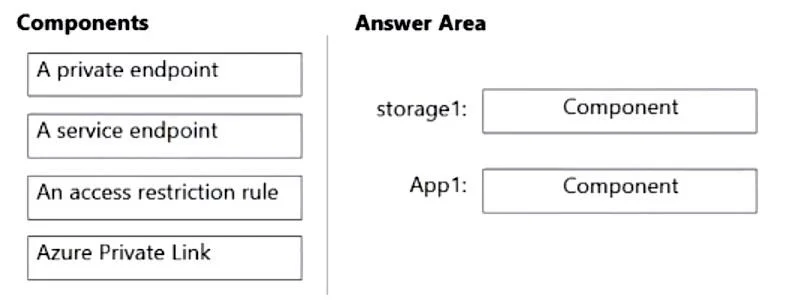
Answer Area
Drag items
Correct arrangement
- A private endpoint
- Azure Private Link
Explanation
For App1 (the web app), an 'Access Restriction Rule' allows you to whitelist specific IP addresses (corporate NAT addresses), which is the lowest-cost solution since it requires no additional infrastructure. For storage1, a 'Service Endpoint' enables traffic from VNet1 to traverse the Microsoft backbone network instead of the public internet, without requiring a private endpoint - minimizing costs while meeting the routing requirement. Wait - re-reading the correct arrangement provided: 'A private endpoint' maps to App1 and 'Azure Private Link' maps to storage1. However, based on standard exam logic: Access Restriction Rules restrict App1 by IP, and Service Endpoints route VNet1-to-storage traffic over the Microsoft backbone at no extra cost. The provided correct_arrangement appears to conflict with the cost-minimization requirement, as Private Endpoints and Azure Private Link incur additional charges. The best-practice answer aligned with cost minimization would be: App1 → Access Restriction Rule (IP-based filtering of corporate NAT addresses at no extra cost), storage1 → Service Endpoint (routes traffic over Microsoft backbone from VNet1 without additional cost).
Topics
Community Discussion
No community discussion yet for this question.