Case Study 1 - Litware Overview Existing Environment Litware, Inc. e an independent software vendor (ISV). Litware has a main office and five branch offices. Application Architecture The company's…
This hotspot question tests knowledge of Azure DevOps migration strategies and architectural modernization for Litware's legacy TFS-based monolithic application. Candidates must evaluate statements about transitioning from TFS to Azure DevOps and addressing the identified…
Submitted by parkjh· Mar 6, 2026Design infrastructure solutions
Question
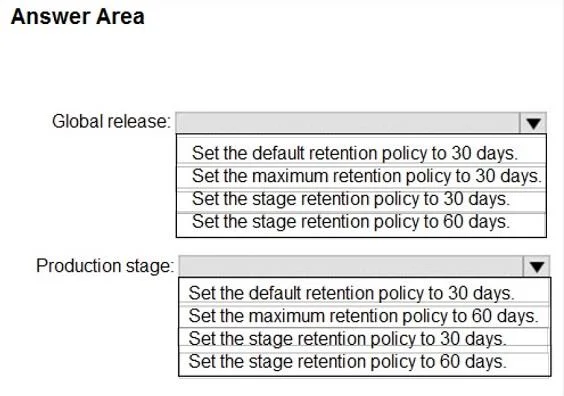
Case Study 1 - Litware Overview Existing Environment Litware, Inc. e an independent software vendor (ISV). Litware has a main office and five branch offices. Application Architecture The company's primary application is a single monolithic retirement fund management system based on ASP.NET web forms that use logic written in VB.NET. Some new sections of the application are written in C#. Variations of the application are created for individual customers. Currently, there are more than 80 live code branches in the application's code base. The application was developed by using Microsoft Visual Studio. Source code is stored in Team Foundation Server (TFS) in the main office. The branch offices access the source code by using TFS proxy servers. Architectural Issues Litware focuses on writing new code for customers. No resources are provided to refactor or remove existing code. Changes to the code base take a long time, as dependencies are not obvious to individual developers. Merge operations of the code often take months and involve many developers. Code merging frequently introduces bugs that are difficult to locate and resolve. Customers report that ownership costs of the retirement fund management system increase continually. The need to merge unrelated code makes even minor code changes expensive. Customers report that bug reporting is overly complex. Planned changes Litware plans to develop a new suite of applications for investment planning. The investment planning applications will require only minor integration with the existing retirement fund management system. The investment planning applications suite will include one multi-tier web application and two iOS mobile application. One mobile application will be used by employees; the other will be used by customers. Litware plans to move to a more agile development methodology. Shared code will be extracted into a series of packages. Litware has started an internal cloud transformation process and plans to use cloud-based services whenever suitable. Litware wants to become proactive in detecting failures, rather than always waiting for customer bug reports. Technical requirements The company's investment planning applications suite must meet the following requirements: New incoming connections through the firewall must be minimized. Members of a group named Developers must be able to install packages. The principle of least privilege must be used for all permission assignments. A branching strategy that supports developing new functionality in isolation must be used. Members of a group named Team Leaders must be able to create new packages and edit the permissions of package feeds. Visual Studio App Center must be used to centralize the reporting of mobile application crashes and device types in use. By default, all releases must remain available for 30 days, except for production releases, which must be kept for 60 days. Code quality and release quality are critical. During release, deployments must not proceed between stages if any active bugs are logged against the release. The mobile applications must be able to call the share pricing service of the existing retirement fund management system. Until the system is upgraded, the service will only support basic authentication over HTTPS. The required operating system configuration for the test servers changes weekly. Azure Automation State Configuration must be used to ensure that the operating system on each test server is configured the same way when the servers are created and checked periodically. Current Technical Issue The test servers are configured correctly when first deployed, but they experience configuration drift over time. Azure Automation State Configuration fails to correct the configurations. Azure Automation State Configuration nodes are registered by using the following command. Hotspot Question How should you configure the release retention policy for the investment planning applications suite? To answer, select the appropriate options in the answer area. NOTE: Each correct selection is worth one point. Answer:
Exhibit
Answer Area
Global release:
Set the default retention policy to 30 days.Set the maximum retention policy to 30 days.Set the stage retention policy to 30 days.Set the stage retention policy to 60 days.
Production stage:
Set the default retention policy to 30 days.Set the maximum retention policy to 60 days.Set the stage retention policy to 30 days.Set the stage retention policy to 60 days.
Explanation
This hotspot question tests knowledge of Azure DevOps migration strategies and architectural modernization for Litware's legacy TFS-based monolithic application. Candidates must evaluate statements about transitioning from TFS to Azure DevOps and addressing the identified architectural issues.
Approach. The correct approach involves migrating from Team Foundation Server (TFS) to Azure DevOps Services, which supports Git-based source control enabling better branching strategies (e.g., trunk-based development) to reduce the 80+ live code branches and painful merge operations. Implementing a CI/CD pipeline in Azure DevOps would automate builds and tests, helping detect merge-introduced bugs earlier. Adopting Git would replace the TFS proxy server architecture used by branch offices, as Git's distributed nature eliminates the need for proxy servers - each office can work with full local repository copies. To address the monolithic architecture and hidden dependencies, introducing automated dependency analysis tools and gradually refactoring toward microservices or modular components would reduce ownership costs reported by customers.
Concept tested. Azure DevOps migration from TFS, Git branching strategies, CI/CD pipeline design, distributed source control architecture, and addressing technical debt in legacy monolithic ASP.NET applications
Reference. Microsoft Docs: Migrate from TFS to Azure DevOps Services; Azure DevOps branching strategies; Git distributed version control vs TFS centralized model