
Microsoft
AZ-305 · Question #120
Hotspot Question Your organization has developed and deployed several Azure App Service Web and API applications. The applications use Azure Key Vault to store several authentication, storage…
The correct answer is Security: Azure AD Privileged Identity Management; Development: Azure AD Managed Service Identity; Quality Assurance: Azure AD Privileged Identity Management. 1. Security => Azure AD Privileged Identity Management (PIM): Request: The Security department needs to review and justify administrative role memberships, receive alerts on admin assignment changes, and view a history of administrator activations and resource changes…
Submitted by yaw92· Mar 6, 2026Design identity, governance, and monitoring solutions
Question
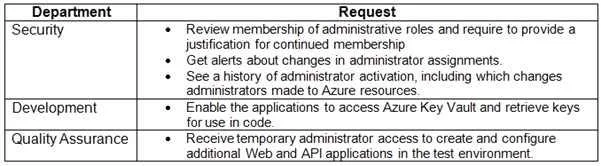
Hotspot Question Your organization has developed and deployed several Azure App Service Web and API applications. The applications use Azure Key Vault to store several authentication, storage account, and data encryption keys. Several departments have the following requests to support the applications: You need to recommend the appropriate Azure service for each department request. What should you recommend? To answer, configure the appropriate options in the dialog box in the answer area. NOTE: Each correct selection is worth one point. Answer:
Exhibits
Answer Area
- SecurityAzure AD Privileged Identity ManagementAzure AD Privileged Identity ManagementAzure AD Managed Service IdentityAzure AD ConnectAzure AD Identity Protection
- DevelopmentAzure AD Managed Service IdentityAzure AD Privileged Identity ManagementAzure AD Managed Service IdentityAzure AD ConnectAzure AD Identity Protection
- Quality AssuranceAzure AD Privileged Identity ManagementAzure AD Privileged Identity ManagementAzure AD Managed Service IdentityAzure AD ConnectAzure AD Identity Protection
Explanation
-
Security => Azure AD Privileged Identity Management (PIM):
- Request: The Security department needs to review and justify administrative role memberships, receive alerts on admin assignment changes, and view a history of administrator activations and resource changes.
- Rationale: Azure AD PIM is designed to manage and monitor privileged access. Its features directly address these requirements by enabling access reviews to ensure continued need for roles, requiring justification for role activation, providing notifications when privileged roles are activated, and allowing the download of audit history for administrative actions. PIM mitigates risks associated with excessive or misused access permissions.
-
Development => Azure AD Managed Service Identity (MSI):
- Request: The Development department needs to enable applications to securely access Azure Key Vault and retrieve keys without storing credentials in code.
- Rationale: Managed identities provide an identity for applications (like Azure App Service Web and API applications) to use for Azure AD authentication. This allows applications to obtain Azure AD tokens to securely access other Azure resources that support Azure AD authentication, such as Azure Key Vault, without needing to manage secrets or credentials in their code.
-
Quality Assurance => Azure AD Privileged Identity Management (PIM):
- Request: The Quality Assurance department requires temporary administrator access to create and configure applications in a test environment.
- Rationale: Azure AD PIM is ideal for this scenario as it provides just-in-time privileged access to Azure resources. It allows for time-bound access assignments with start and end dates, ensuring that administrative access is temporary and provisioned only when needed, aligning with the requirement for temporary administrator access.
Topics
#Privileged Identity Management#Managed Service Identity#Azure AD#Access Control
Community Discussion
No community discussion yet for this question.