AZ-204 · Question #526
AZ-204 Question #526: Real Exam Question with Answer & Explanation
The correct arrangement for setting up Azure Content Delivery Network (CDN) follows a strict dependency order: first create the CDN Profile (the top-level container), then create an Origin Group (which holds origins for load balancing), then configure a new CDN Origin (the backen
Question
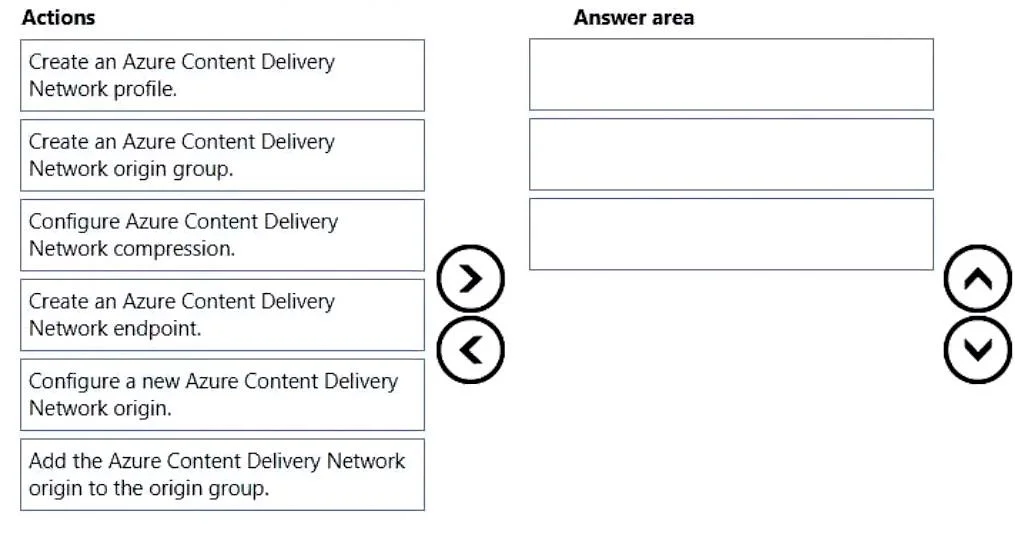
Case Study 9 - Munson's Pickles and Preserves Farm Background Munson's Pickles and Preserves Farm is an agricultural cooperative corporation based in Washington, US, with farms located across the United States. The company supports agricultural production resources by distributing seeds fertilizers, chemicals, fuel, and farm machinery to the farms. Current Environment The company is migrating all applications from an on-premises datacenter to Microsoft Azure. Applications support distributors, farmers, and internal company staff. Corporate website The company hosts a public website located at who request agricultural production resources. Farms The company created a new customer tenant in the Microsoft Entra admin center to support authentication and authorization for applications. Distributors Distributors integrate their applications with data that is accessible by using APIs hosted at Requirements The application components must meet the following requirements: Corporate website - The site must be migrated to Azure App Service. - Costs must be minimized when hosting in Azure. - Applications must automatically scale independent of the compute resources. - All code changes must be validated by internal staff before release to production. - File transfer speeds must improve, and webpage-load performance must increase. - All site settings must be centrally stored, secured without using secrets, and encrypted at rest and in transit. - A queue-based load leveling pattern must be implemented by using Azure Service Bus queues to support high volumes of website agricultural production resource requests. Farms - Farmers must authenticate to applications by using Microsoft Entra ID. Distributors - The company must track a custom telemetry value with each API call and monitor performance of all APIs. - API telemetry values must be charted to evaluate variations and trends for resource data. Internal staff - App and API updates must be validated before release to production. - Staff must be able to select a link to direct them back to the production app when validating an app or API update. - Staff profile photos and email must be displayed on the website once they authenticate to applications by using their Microsoft Entra ID. Security - All web communications must be secured by using TLS/HTTPS. - Web content must be restricted by country/region to support corporate compliance standards. - The principle of least privilege must be applied when providing any user rights or process access rights. - Managed identities for Azure resources must be used to authenticate services that support Microsoft Entra ID authentication. Issues Corporate website - Farmers report HTTP 503 errors at the same time as internal staff report that CPU and memory usage are high. - Distributors report HTTP 502 errors at the same time as internal staff report that average response times and networking traffic are high. - Internal staff report webpage load sizes are large and take a long time to load. - Developers receive authentication errors to Service Bus when they debug locally. Distributors - Many API telemetry values are sent in a short period of time. Telemetry traffic, data costs, and storage costs must be reduced while preserving a statistically correct analysis of the data points sent by the APIs. Drag and Drop Question You need to correct the internal staff issue with webpages. Which three actions should you perform in sequence? To answer, move the appropriate actions from the list of actions to the answer area and arrange them in the correct order. Answer:
Explanation
The correct arrangement for setting up Azure Content Delivery Network (CDN) follows a strict dependency order: first create the CDN Profile (the top-level container), then create an Origin Group (which holds origins for load balancing), then configure a new CDN Origin (the backend source), then add the Origin to the Origin Group, then create a CDN Endpoint (which ties the profile to delivery settings), and finally configure CDN Compression (an optional optimization applied after the endpoint exists). Each step depends on the previous one existing before it can be configured, making the sequence non-negotiable. This logical hierarchy ensures the CDN infrastructure is built from the foundational container down to the specific delivery and optimization settings.
Topics
Community Discussion
No community discussion yet for this question.