
AZ-204 · Question #417
Drag and Drop Question Your company has several websites that use a company logo image. You use Azure Content Delivery Network (CDN) to store the static image. You need to determine the correct…
The correct answer is A user requests the image from the CDN URL. The DNS routes the request to the best performing POP location.; If no edge servers in the POP have the image in cache, the POP requests the file from the origin server.; The origin server returns the logo image to an edge server in the POP. An edge server in the POP caches the logo image and returns the image to the client.; Subsequent requests for the file may be directed to the same POP using the CDN logo image URL. The POP edge server returns the file from cache if the TTL has not expired. Azure CDN Request Flow - Explanation This question tests your understanding of how a CDN serves content on first request vs. subsequent requests, and the role of the POP (Point of Presence) edge server as a caching intermediary. --- The Core Concept A CDN has two distinct…
Question
Exhibit
Answer Area
Drag items
Correct arrangement
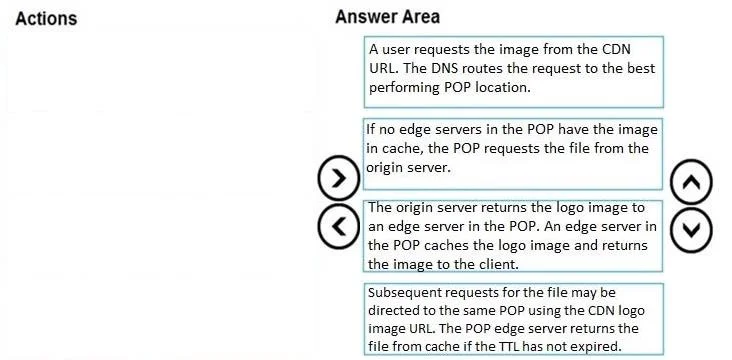
- A user requests the image from the CDN URL. The DNS routes the request to the best performing POP location.
- If no edge servers in the POP have the image in cache, the POP requests the file from the origin server.
- The origin server returns the logo image to an edge server in the POP. An edge server in the POP caches the logo image and returns the image to the client.
- Subsequent requests for the file may be directed to the same POP using the CDN logo image URL. The POP edge server returns the file from cache if the TTL has not expired.
Explanation
Azure CDN Request Flow - Explanation
This question tests your understanding of how a CDN serves content on first request vs. subsequent requests, and the role of the POP (Point of Presence) edge server as a caching intermediary.
The Core Concept
A CDN has two distinct phases: cache miss (first request, content must be fetched from origin) and cache hit (subsequent requests, content served from edge). The correct order maps to this lifecycle.
Item-by-Item Breakdown
1. "A user requests the image from the CDN URL. The DNS routes the request to the best performing POP location."
This must be first - it's the trigger. Every CDN flow starts with a client request. DNS resolution happens at this step using Anycast routing to select the geographically or network-optimal POP. Nothing else can happen without this initial request.
2. "If no edge servers in the POP have the image in cache, the POP requests the file from the origin server."
This is second because it's the cache miss check. After the request lands at the POP, the edge server checks its local cache. On the very first request, the cache is empty, so it must forward the request upstream to the origin server. This step only applies when TTL has expired or the asset was never cached.
3. "The origin server returns the logo image to an edge server in the POP. An edge server in the POP caches the logo image and returns the image to the client."
Third, because this is the origin response + cache population. The origin fulfills the request, the edge server stores the response locally (setting the TTL clock), and simultaneously delivers it to the waiting client. Caching and responding happen together in this step.
4. "Subsequent requests for the file may be directed to the same POP using the CDN logo image URL. The POP edge server returns the file from cache if the TTL has not expired."
Last, because this describes the cache hit path - only possible after step 3 has already populated the cache. "Subsequent" is the keyword: this step is impossible without a prior successful origin fetch.
Common Mistakes
- Swapping steps 2 and 3 - Some assume the origin is contacted before checking the cache. In reality, the cache check always comes first; origin is only contacted on a miss.
- Putting step 4 before step 3 - The cache cannot serve content that hasn't been stored yet. Serving from cache is always a consequence of a prior cache population.
- Thinking DNS resolution is a separate step - DNS routing and the user request are bundled into step 1 because they happen as part of the same initial resolution flow, not as distinct CDN-controlled operations.
Summary Table
| Step | Event | Cache State |
|---|---|---|
| 1 | User requests -> DNS routes to best POP | Unknown |
| 2 | POP checks cache -> miss -> requests origin | Empty/Expired |
| 3 | Origin responds -> edge caches + serves client | Populated |
| 4 | Future requests served from edge cache | Valid (TTL not expired) |
Topics
Community Discussion
No community discussion yet for this question.