
AZ-204 · Question #371
Drag and Drop Question You are a developer for a software as a service (SaaS) company that uses an Azure Function to process orders. The Azure Function currently runs on an Azure Function app that…
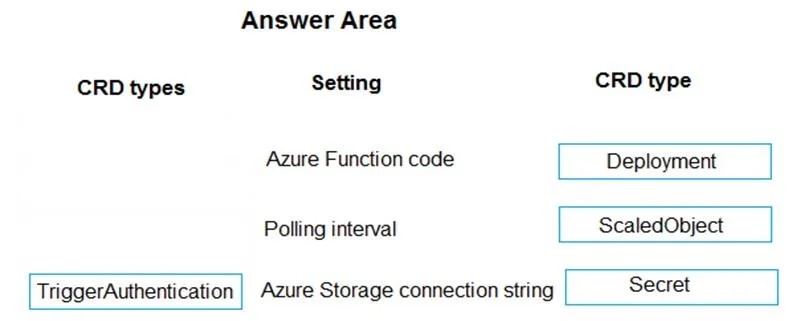
The correct answer is Deployment; ScaledObject; Secret. When migrating an Azure Function to Kubernetes with KEDA, you need three CRDs: a Deployment to define and run the containerized Azure Function workload in Kubernetes, a ScaledObject to configure KEDA's autoscaling rules that link the deployment to the Azure Storage Queue…
Question
Exhibit
Answer Area
Drag items
Correct arrangement
- Deployment
- ScaledObject
- Secret
Explanation
When migrating an Azure Function to Kubernetes with KEDA, you need three CRDs: a Deployment to define and run the containerized Azure Function workload in Kubernetes, a ScaledObject to configure KEDA's autoscaling rules that link the deployment to the Azure Storage Queue trigger, and a Secret to securely store the Azure Storage connection string credentials that KEDA uses to monitor the queue. The ScaledObject references the Deployment and defines scaling behavior (min/max replicas, trigger type), while the Secret holds sensitive connection information consumed by the scaler.
Topics
Community Discussion
No community discussion yet for this question.