
AZ-140 · Question #259
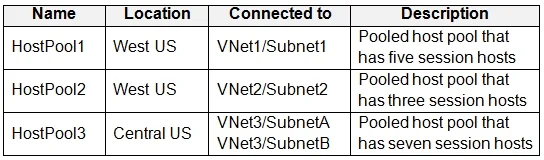
You have an Azure Virtual Desktop deployment that contains the host pools shown in the following table. VNet1, VNet2, and VNet3 are peered. You plan to use Azure Bastion to provide secure…
The correct answer is A. 1. Azure Bastion Standard SKU supports VNet peering, meaning a single Bastion host deployed in one VNet can provide secure RDP/SSH access to virtual machines in all peered VNets. Since VNet1, VNet2, and VNet3 are all peered, one Bastion host deployed in any of those VNets provides…
Question
You have an Azure Virtual Desktop deployment that contains the host pools shown in the following table. VNet1, VNet2, and VNet3 are peered. You plan to use Azure Bastion to provide secure administrative access to all the session hosts. The solution must minimize costs. How many Azure Bastion hosts should you deploy?
Exhibit
Options
- A1
- B2
- C3
- D4
How the community answered
(58 responses)- A71% (41)
- B5% (3)
- C10% (6)
- D14% (8)
Explanation
Azure Bastion Standard SKU supports VNet peering, meaning a single Bastion host deployed in one VNet can provide secure RDP/SSH access to virtual machines in all peered VNets. Since VNet1, VNet2, and VNet3 are all peered, one Bastion host deployed in any of those VNets provides coverage for session hosts across all three. Deploying additional Bastion hosts would be redundant and increase costs unnecessarily. The Basic SKU does NOT support peered VNet access, so the Standard SKU must be used - but only one instance is required.
Topics
Community Discussion
No community discussion yet for this question.