
AZ-104 · Question #444
Hotspot Question You manage two Azure subscriptions named Subscription1 and Subscription2. Subscription1 has following virtual networks: The virtual networks contain the following subnets…
The correct answer is A Site-to-Site connection can be established between VNET1 and VNET2. = No; VNET1 and VNET2 can be peered. = No; VNET1 and VNETA can be peered. = No. Azure Virtual Network peering and Site-to-Site (VNet-to-VNet) connections require non-overlapping IP address spaces, making all three statements 'No'.
Question
Exhibits
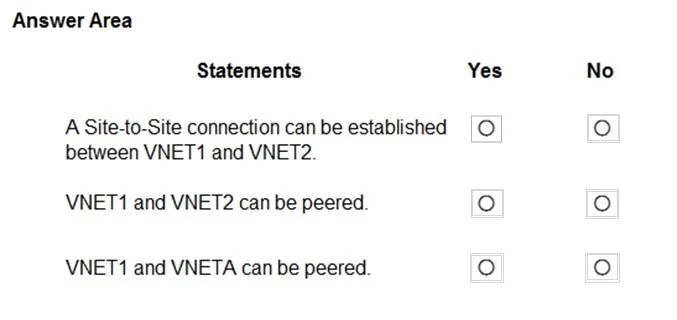
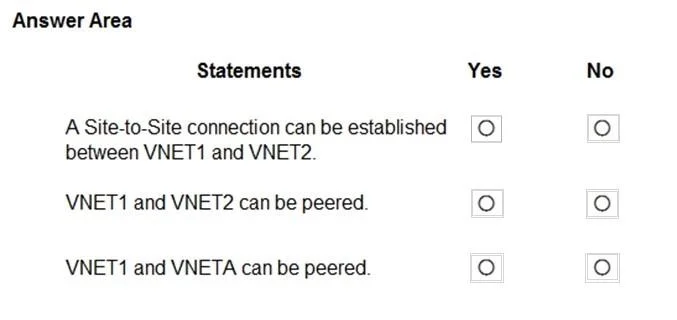
Answer Area
- A Site-to-Site connection can be established between VNET1 and VNET2.No
- VNET1 and VNET2 can be peered.No
- VNET1 and VNETA can be peered.No
Explanation
Azure Virtual Network peering and Site-to-Site (VNet-to-VNet) connections require non-overlapping IP address spaces, making all three statements 'No'.
Approach. Although the prompt text cuts off the specific configurations of VNET1 and VNET2, this is a standard and well-known exam scenario where both VNET1 and VNET2 are configured with the exact same address space: 10.10.0.0/16.
-
A Site-to-Site connection can be established between VNET1 and VNET2 (No): A Site-to-Site (VNet-to-VNet) VPN connection requires the virtual networks to have non-overlapping IP spaces. Because VNET1 and VNET2 both use
10.10.0.0/16, they overlap and cannot establish this connection. -
VNET1 and VNET2 can be peered (No): For the same reason, VNET1 and VNET2 cannot be peered. Azure VNet peering strictly prohibits overlapping address spaces.
-
VNET1 and VNETA can be peered (No): VNET1 uses
10.10.0.0/16, which covers the IP range 10.10.0.0 through 10.10.255.255. VNETA uses10.10.128.0/17, which covers the IP range 10.10.128.0 through 10.10.255.255. Because VNETA's IP range is completely subsumed within VNET1's range, the address spaces overlap. Therefore, VNET1 and VNETA cannot be peered.
The correct sequence is strictly No, No, No.
Common mistakes.
- common_mistake. The second exhibit shows 'No, Yes, Yes', which is a flawed answer key. Test-takers often mistakenly assume that because VNETA uses a different CIDR suffix (/17 vs /16) or resides in a different subscription, it does not overlap. In reality, CIDR overlap is evaluated at the IP range level, and the /17 block falls entirely inside the /16 block. Furthermore, the dump's logic is inherently contradictory: if two VNets didn't overlap and could be peered, they would generally also be eligible for a Site-to-Site connection.
Concept tested. Azure Virtual Network (VNet) Peering constraints and CIDR / Address Space Overlap evaluation.
Reference. https://learn.microsoft.com/en-us/azure/virtual-network/virtual-network-peering-overview
Topics
Community Discussion
No community discussion yet for this question.