
AZ-104 · Question #117
Hotspot Question You have an Azure subscription named Subscription1. Subscription1 contains the virtual networks in the following table. Subscription1 contains the virtual machines in the following…
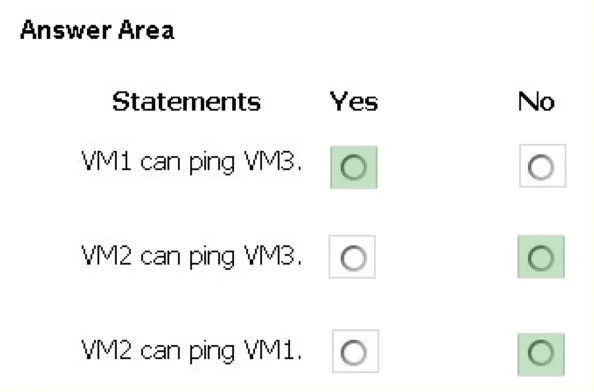
The correct answer is VM1 can ping VM3. = Yes; VM2 can ping VM3. = No; VM2 can ping VM1. = No. This question tests understanding of Azure Virtual Network Peering, specifically how peering relationships work (non-transitive nature), and whether VMs in different VNets can communicate based on the peering configurations provided.
Question
Exhibit
Answer Area
- VM1 can ping VM3.Yes
- VM2 can ping VM3.No
- VM2 can ping VM1.No
Explanation
This question tests understanding of Azure Virtual Network Peering, specifically how peering relationships work (non-transitive nature), and whether VMs in different VNets can communicate based on the peering configurations provided.
Approach. Azure VNet peering is non-transitive by default, meaning if VNet A is peered with VNet B, and VNet B is peered with VNet C, VMs in VNet A cannot communicate with VMs in VNet C unless a direct peering exists between A and C. To determine connectivity, you must trace the explicit peering links: only VMs whose VNets have a direct peering relationship (with both 'Allow Virtual Network Access' enabled on both sides) can communicate via ICMP. Also, VMs within the same VNet can always communicate. When analyzing each statement, check whether a direct peering path exists between the VNets of the two VMs in question - if yes, communication is possible (Yes); if connectivity relies on transitive routing through an intermediate VNet without User Defined Routes or a hub/spoke gateway configuration, the answer is No.
Concept tested. Azure Virtual Network Peering - non-transitive peering behavior, direct vs. indirect connectivity between VMs across peered VNets, and the requirement for explicit bi-directional peering links for network communication.
Reference. https://learn.microsoft.com/en-us/azure/virtual-network/virtual-network-peering-overview
Topics
Community Discussion
No community discussion yet for this question.