
ARA-C01 · Question #38
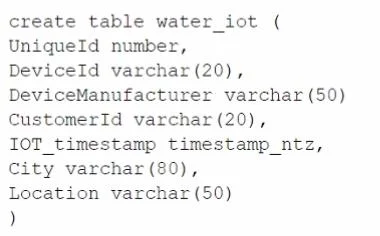
A table for IOT devices that measures water usage is created. The table quickly becomes large and contains more than 2 billion rows. The general query patterns for the table are: 1. DeviceId…
The correct answer is C. Deviceld and Customerld. Clustering keys should be chosen based on columns most frequently used in filter predicates (WHERE clauses), as they determine how Snowflake organizes micro-partitions for efficient pruning. Per the query patterns, DeviceId, IOT_timestamp, and CustomerId are all used in…
Question
Exhibit
Options
- AlOT_timestamp
- BCity and DeviceManuf acturer
- CDeviceld and Customerld
- DUniqueld
How the community answered
(40 responses)- A3% (1)
- B8% (3)
- C75% (30)
- D15% (6)
Explanation
Clustering keys should be chosen based on columns most frequently used in filter predicates (WHERE clauses), as they determine how Snowflake organizes micro-partitions for efficient pruning. Per the query patterns, DeviceId, IOT_timestamp, and CustomerId are all used in filters. However, IOT_timestamp is a poor clustering key alone because it is monotonically increasing and high-cardinality, causing poor partition overlap. DeviceId and CustomerId (Option C) represent categorical identifiers with better cardinality characteristics for clustering. Option B (City and DeviceManufacturer) are only retrieved, not filtered. Option D (UniqueId) is used in COUNT aggregation, not filtering, and is too high-cardinality for effective clustering.
Topics
Community Discussion
No community discussion yet for this question.