
Microsoft
70-776 · Question #15
You have a fact table named PowerUsage that has 10 billion rows. PowerUsage contains data about customer power usage during the last 12 months. The usage data is collected every minute. PowerUsage…
Sign in or unlock 70-776 to reveal the answer and full explanation for question #15. The question stem and answer options stay visible for context.
Question
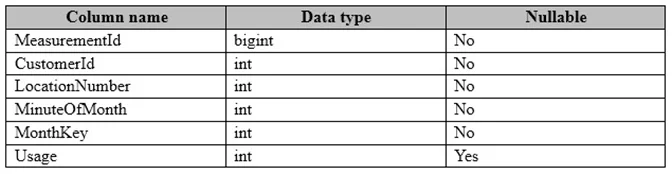
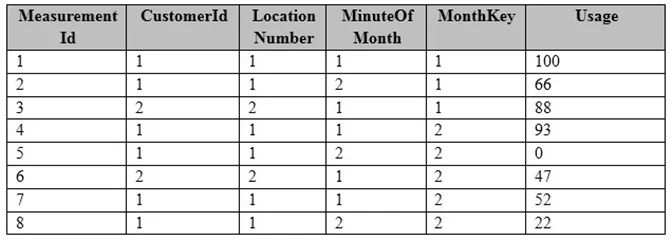
You have a fact table named PowerUsage that has 10 billion rows. PowerUsage contains data about customer power usage during the last 12 months. The usage data is collected every minute. PowerUsage contains the columns configured as shown in the following table. LocationNumber has a default value of 1. The MinuteOfMonth column contains the relative minute within each month. The value resets at the beginning of each month. A sample of the fact table data is shown in the following table. There is a related table named Customer that joins to the PowerUsage table on the CustomerId column. Sixty percent of the rows in PowerUsage are associated to less than 10 percent of the rows in Customer. Most queries do not require the use of the Customer table. Many queries select on a specific month. You need to minimize how long it takes to find the records for a specific month. What should you do?
Exhibits
Options
- AImplement partitioning by using the MonthKey column.
- BImplement partitioning by using the CustomerId column.
- CImplement partitioning by using the MonthKey column.
- DImplement partitioning by using the MinuteOfMonth column.
Unlock 70-776 to see the answer
You've previewed enough free 70-776 questions. Unlock 70-776 for full answers, explanations, the timed quiz mode, progress tracking, and the master PDF. Question stem and options stay visible so you can still see what's on the exam.