
70-647 · Question #69
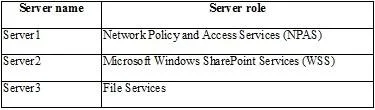
Your network consists of one Active Directory domain. The domain contains servers that run Windows Server 2008. The servers are configured as shown in the following table. (Click the Exhibit) All…
The correct answer is D. Secure Socket Tunneling Protocol (SSTP). To plan a solution that would allow the remote users using firewall on their remote locations to access files on Server3 through a VPN connection, you need to configure Secure Socket Tunneling Protocol (SSTP) connection. Before Windows Server 2008, all kinds of VPN connections…
Question
Your network consists of one Active Directory domain. The domain contains servers that run Windows Server 2008. The servers are configured as shown in the following table. (Click the Exhibit) All client computers run Windows Vista Service Pack 1 (SP1). Remote domain users at a customer site report that they can access Server2 from the Internet by using the URL https://portal.contoso.com. They also report that a firewall at the customer site prevents all other outbound connections. You need to implement a solution to enable remote users to access files on Server3 from a VPN connection. Which connection should you enable on Server1?
Exhibit
Options
- AIPsec tunnel mode
- BL2TP
- CPPTP
- DSecure Socket Tunneling Protocol (SSTP)
How the community answered
(28 responses)- A7% (2)
- B18% (5)
- C4% (1)
- D71% (20)
Explanation
To plan a solution that would allow the remote users using firewall on their remote locations to access files on Server3 through a VPN connection, you need to configure Secure Socket Tunneling Protocol (SSTP) connection. Before Windows Server 2008, all kinds of VPN connections such as PPTP L2TP, and IPSec had problems with firewalls, NATs, and Web proxies. To prevent problems, firewalls must be configured to allow connections. If your VPN client computer is behind a NAT, both the VPN client and the VPN server must support IPsec NAT-Traversal (NAT-T). Besides, VPN server can't be located behind a NAT, and that L2TP/IPsec traffic can't flow through a Web proxy. With the advent of SSTP in Windows Server 2008 all the VPN connectivity problems such as firewalls, NATs, and Web proxies are solved. The SSTP connection allows the use of HTTP over secure sockets layer (SSL). SSTP uses an HTTP-over-SSL session between VPN clients and servers to exchange encapsulated IPv4 or IPv6 packets.
Topics
Community Discussion
No community discussion yet for this question.