
70-516 · Question #64
You use Microsoft Visual Studio 2010 and Microsoft .NET Framework 4.0 to develop an application. You use the ADO.NET Entity Framework Designer to model entities. The application includes…
Sign in or unlock 70-516 to reveal the answer and full explanation for question #64. The question stem and answer options stay visible for context.
Question
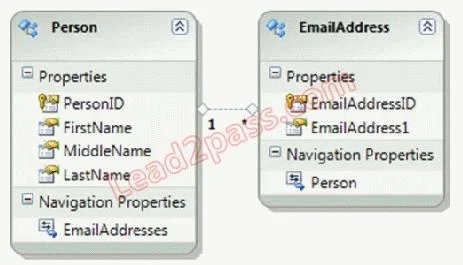
You use Microsoft Visual Studio 2010 and Microsoft .NET Framework 4.0 to develop an application. You use the ADO.NET Entity Framework Designer to model entities. The application includes self-tracking entities as shown in the following diagram. There is a Person entity names person1 that has TrackChanges turned on. You need to delete all e-mail addresses that are associated with person1 by using an ObjectContext. What are two possible code segments that you can use to achieve this goal? (Each correct answer presents a complete solution. Choose two).
Exhibit
Options
- Aforeach(var email in person1.EMailAddresses){
- Bwhile(person1.EMailAddresses.Count>0){
- Cperson1.EMailAddresses = null;
- Dperson1.EMailAddresses = new TrackableCollection<EMailAddress>();
Unlock 70-516 to see the answer
You've previewed enough free 70-516 questions. Unlock 70-516 for full answers, explanations, the timed quiz mode, progress tracking, and the master PDF. Question stem and options stay visible so you can still see what's on the exam.