
70-467 · Question #6
You are developing the database schema for a SQL Server Analysis Services (SSAS) BI Semantic Model (BISM). The BISM will be based on the schema displayed in the following graphic. You have the…
The correct answer is A. Create a multidimensional project and define measures and a many-to-many dimensional. A multidimensional SSAS project with a many-to-many dimensional relationship is the correct model when a bridge fact table links students to classes and accurate average aggregations are required.
Question
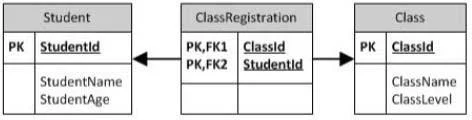
You are developing the database schema for a SQL Server Analysis Services (SSAS) BI Semantic Model (BISM). The BISM will be based on the schema displayed in the following graphic. You have the following requirements:
- Ensure that queries of the data model correctly display average
student age by class.
- Ensure that the solution supports role-based security and partitions.
- Minimize development effort.
You need to design the data model. What should you do? (More than one answer choice may achieve the goal. Select the BEST answer.)
Exhibit
Options
- ACreate a multidimensional project and define measures and a many-to-many dimensional
- BCreate a multidimensional project and define measures and a reference relationship.
- CCreate a tabular project and define measures.
- DCreate a tabular project and define calculated columns.
How the community answered
(49 responses)- A59% (29)
- B24% (12)
- C12% (6)
- D4% (2)
Why each option
A multidimensional SSAS project with a many-to-many dimensional relationship is the correct model when a bridge fact table links students to classes and accurate average aggregations are required.
A many-to-many dimensional relationship in a multidimensional project uses a bridge measure group to correctly route aggregations across both dimension tables, which is necessary when a student can belong to multiple classes and the average must not double-count. Multidimensional models natively support role-based security at the dimension and cell level, as well as measure group partitions, satisfying all stated requirements with standard, wizard-driven tooling that minimizes development effort.
A reference relationship routes dimension queries through an intermediate dimension rather than through a bridge fact table, so it cannot correctly resolve many-to-many aggregations and would produce inflated or incorrect averages for student age by class.
A tabular project with standard measures does not natively resolve many-to-many join semantics without explicit DAX bidirectional filter configuration, requiring additional development effort to produce correct averages.
Calculated columns compute row-level scalar values during data refresh and do not perform aggregation across relationships, making them unsuitable for computing an average student age aggregated across a many-to-many class enrollment relationship.
Concept tested: SSAS many-to-many dimension relationship design
Source: https://learn.microsoft.com/en-us/analysis-services/multidimensional-models/define-a-many-to-many-relationship-and-many-to-many-relationship-properties
Topics
Community Discussion
No community discussion yet for this question.