
70-467 · Question #25
You are creating a Multidimensional Expressions (MDX) calculation for Projected Revenue in a cube. For Customer A, Projected Revenue is defined as 150 percent of the Total Sales for the customer…
The correct answer is C. Option C. The correct MDX option uses an IIF conditional expression to apply a 1.5 multiplier for Customer A and a 1.1 multiplier for all other customers in a single efficient calculation pass.
Question
You are creating a Multidimensional Expressions (MDX) calculation for Projected Revenue in a cube. For Customer A, Projected Revenue is defined as 150 percent of the Total Sales for the customer. For all other customers, Projected Revenue is defined as 110 percent of the Total Sales for the customer. You need to calculate the Projected Revenue as efficiently as possible. Which calculation should you use? (More than one answer choice may achieve the goal. Select the BEST answer.)
Exhibit
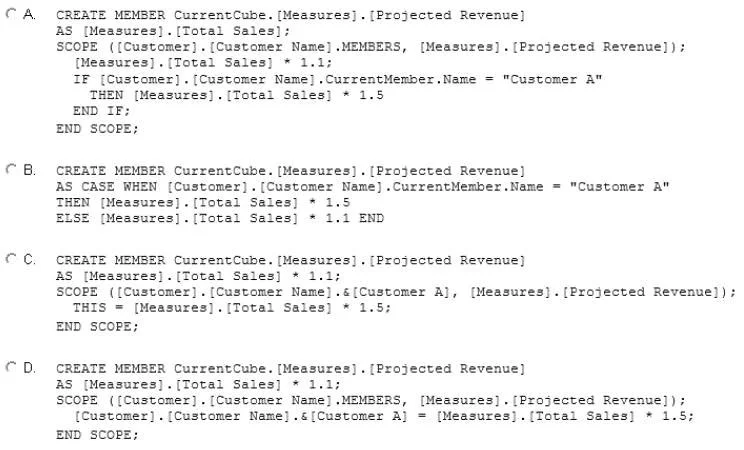
Options
- AOption A
- BOption B
- COption C
- DOption D
How the community answered
(24 responses)- A4% (1)
- B8% (2)
- C83% (20)
- D4% (1)
Why each option
The correct MDX option uses an IIF conditional expression to apply a 1.5 multiplier for Customer A and a 1.1 multiplier for all other customers in a single efficient calculation pass.
Option A likely uses a calculation structure requiring multiple passes or improperly scopes the conditional, introducing unnecessary formula engine overhead compared to a direct IIF expression.
Option B likely relies on nested SCOPE assignments or a CASE-style construct that increases the number of calculation passes needed to resolve the projected revenue value.
The correct option evaluates a single IIF branch at the cell level to test whether the current Customer member is Customer A, then multiplies Total Sales by 1.5 or 1.1 accordingly. This approach resolves the conditional in one calculation pass without requiring multiple SCOPE statements or nested expressions, which is the most performant pattern for a binary member-specific override in MDX. Using IIF directly on a member key comparison avoids redundant formula engine calls that would occur with less efficient structural alternatives.
Option D likely applies the multiplier incorrectly or uses an inefficient expression that does not properly isolate the Customer A override from the general 110 percent rule, producing either wrong results or slower evaluation.
Concept tested: MDX IIF conditional calculation for member-specific projected revenue
Source: https://learn.microsoft.com/en-us/analysis-services/multidimensional-models/mdx/mdx-calculated-members-building-calculated-members
Topics
Community Discussion
No community discussion yet for this question.