
70-465 · Question #160
You are designing a Windows Azure SQL Database for an order fulfillment system. You create a table named Sales.Orders with the following script. Each order is tracked by using one of the following…
The correct answer is B. Create a new table named Sales.OrderStatus that contains three columns named OrderID. This question tests the ability to design a normalized database schema that tracks order status history while minimizing storage overhead.
Question
Exhibit
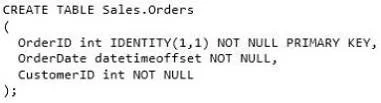
Options
- ATo the Sales.Orders table, add three columns named Status, PreviousStatus and ChangeDate.
- BCreate a new table named Sales.OrderStatus that contains three columns named OrderID,
- CImplement change data capture on the Sales.Orders table.
- DTo the Sales.Orders table, add three columns named FulfilledDate, ShippedDate, and ReceivedDate.
How the community answered
(37 responses)- A24% (9)
- B59% (22)
- C11% (4)
- D5% (2)
Why each option
This question tests the ability to design a normalized database schema that tracks order status history while minimizing storage overhead.
Adding Status, PreviousStatus, and ChangeDate columns directly to Sales.Orders only stores one level of history (current and one previous status), which is a denormalized design that does not scale well and wastes storage if more history is ever needed.
Creating a separate Sales.OrderStatus table with columns for OrderID, Status, and ChangeDate is the most normalized and storage-efficient approach for tracking status history. This design allows multiple status records per order to capture the full history, and by querying the two most recent rows per OrderID, you can retrieve both the current and previous status along with the change date. A separate table avoids denormalization and scales cleanly without requiring schema changes as business requirements evolve.
Change Data Capture (CDC) is a heavy auditing mechanism designed for data replication and ETL scenarios, not for application-level status tracking; it incurs significant storage and processing overhead, violating the requirement to minimize storage.
Adding FulfilledDate, ShippedDate, and ReceivedDate columns stores dates but not a flexible status field, requires schema changes for new statuses, and does not directly provide the previous status without complex logic, making it less efficient and less maintainable.
Concept tested: Normalized relational schema design for status history tracking
Source: https://learn.microsoft.com/en-us/azure/azure-sql/database/design-first-database-tutorial
Topics
Community Discussion
No community discussion yet for this question.