
70-465 · Question #156
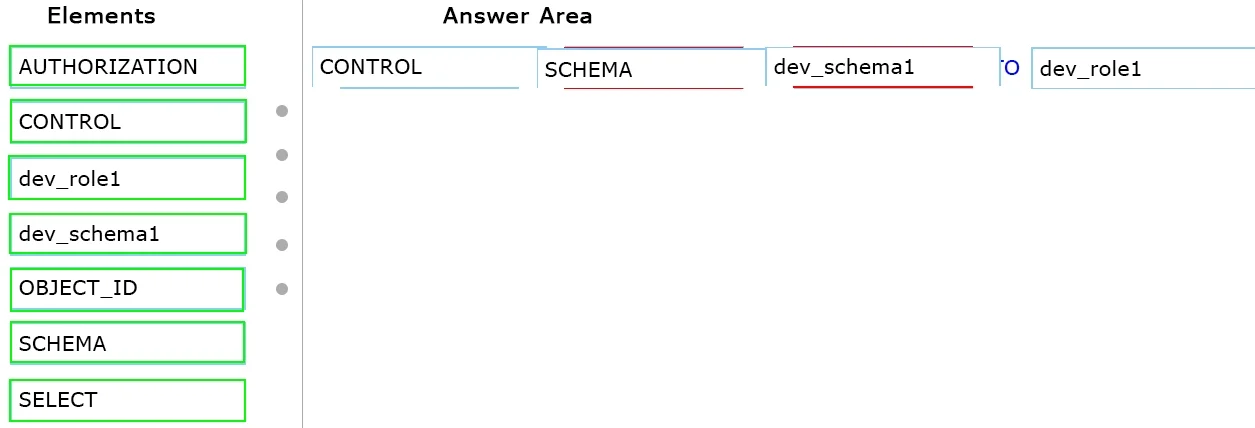
Drag and Drop Question You need to assign security to dev_role1. How should you complete the code? To answer, drag the appropriate elements to the correct locations. Each element may be used once…
The correct answer is B. CONTROL C. dev_role1 D. dev_schema1 F. SCHEMA. SQL Server Security Assignment - Drag-and-Drop Explanation This question builds T-SQL code to assign security to dev_role1. The complete code likely spans two or three statements: ``sql CREATE SCHEMA dev_schema1 AUTHORIZATION dev_role1 GRANT CONTROL ON SCHEMA::dev_schema1 TO…
Question
Exhibit
Options
- AAUTHORIZATION
- BCONTROL
- Cdev_role1
- Ddev_schema1
- EOBJECT_ID
- FSCHEMA
- GSELECT
How the community answered
(42 responses)- A7% (3)
- B71% (30)
- E5% (2)
- G17% (7)
Explanation
SQL Server Security Assignment - Drag-and-Drop Explanation
This question builds T-SQL code to assign security to dev_role1. The complete code likely spans two or three statements:
CREATE SCHEMA dev_schema1 AUTHORIZATION dev_role1

GRANT CONTROL ON SCHEMA::dev_schema1 TO dev_role1

GRANT SELECT ON OBJECT::OBJECT_ID TO dev_role1
Item-by-Item Breakdown
A -> AUTHORIZATION
Used in CREATE SCHEMA dev_schema1 AUTHORIZATION dev_role1. The AUTHORIZATION keyword designates the owner of the schema being created. Without it, the schema defaults to the current user, not the role.
B -> CONTROL
Maps to GRANT CONTROL ON SCHEMA::.... CONTROL is SQL Server's highest schema-level permission - it implies all other permissions on that schema. This gives dev_role1 full authority over dev_schema1.
C -> dev_role1
The principal - the database role receiving all grants. It appears as the AUTHORIZATION target and as the TO recipient in GRANT statements. The question notes elements can be reused; dev_role1 appears in multiple positions.
D -> dev_schema1
The securable object (the schema). It appears in both the CREATE SCHEMA statement and the GRANT ... ON SCHEMA::dev_schema1 clause.
E -> OBJECT_ID
Refers to a specific database object (table, view, etc.) being secured. Used in the GRANT SELECT ON OBJECT::OBJECT_ID statement, targeting a precise object rather than the entire schema.
F -> SCHEMA
The securable class in the GRANT CONTROL ON SCHEMA::dev_schema1 statement. SQL Server requires you to specify the class (SCHEMA, OBJECT, DATABASE, etc.) before the double-colon :: separator.
G -> SELECT
A granular permission granted at the object level. Unlike CONTROL (which is broad/schema-wide), SELECT is a specific DML permission applied to individual objects via GRANT SELECT ON OBJECT::....
Common Mistakes
| Mistake | Why It's Wrong |
|---|---|
Using OBJECT instead of OBJECT_ID for the object-level grant | OBJECT_ID is the actual object reference; OBJECT is the class keyword |
Swapping CONTROL and SELECT | CONTROL is schema-wide authority; SELECT is a narrow, object-level read permission |
Omitting AUTHORIZATION in CREATE SCHEMA | The schema would be owned by the executing user, not dev_role1 |
Mixing up SCHEMA and OBJECT as securable classes | SCHEMA:: precedes schema names; OBJECT:: precedes table/view names |
Putting dev_schema1 where dev_role1 should be | The TO clause always names the principal (role/user), never the object |
Topics
Community Discussion
No community discussion yet for this question.