
70-465 · Question #134
You plan to deploy a database to SQL Azure. You must create two tables named Table 1 and Table 2 that will have the following specifications: - Table1 will contain a date column named Column1 that…
The correct answer is Sparse; Persisted computed. Column1 in Table1 should use the SPARSE option because sparse columns are optimized for storing NULL values - when approximately 80% of values are NULL, sparse columns reduce storage overhead significantly, improving retrieval performance over millions of rows. Column2 in…
Question
Exhibit
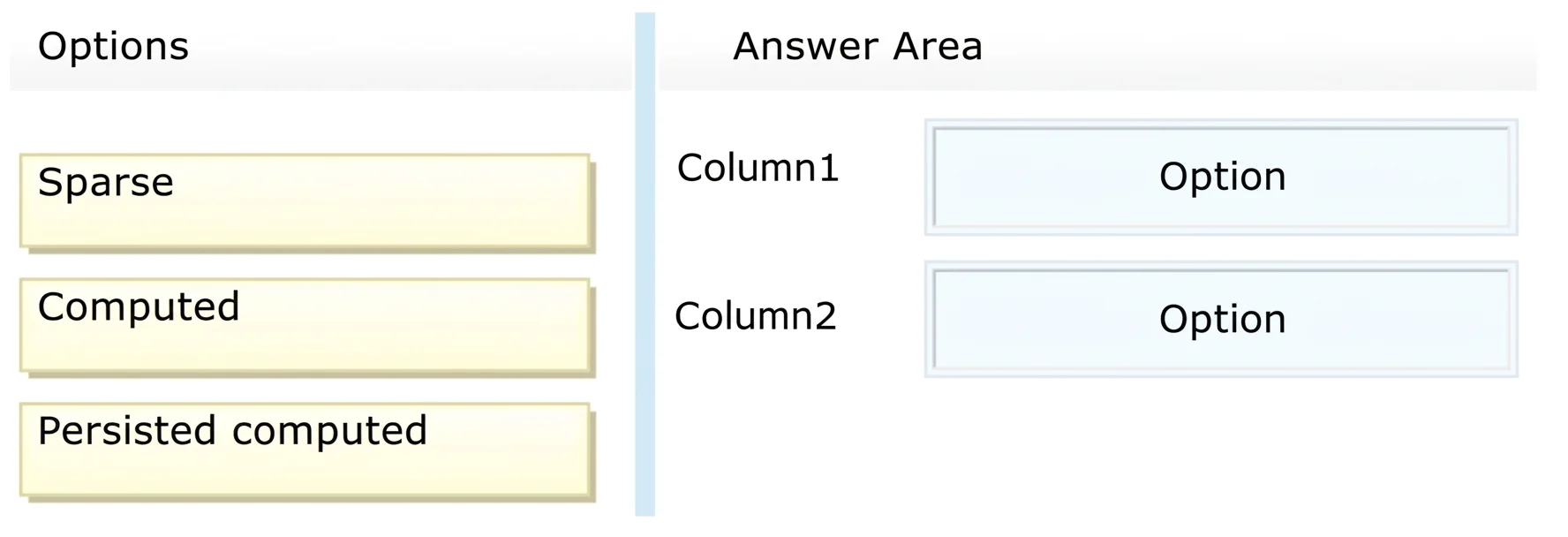
Answer Area
Drag items
Correct arrangement
- Sparse
- Persisted computed
Explanation
Column1 in Table1 should use the SPARSE option because sparse columns are optimized for storing NULL values - when approximately 80% of values are NULL, sparse columns reduce storage overhead significantly, improving retrieval performance over millions of rows. Column2 in Table2 should use PERSISTED COMPUTED because a persisted computed column physically stores the calculated result on disk, meaning the product of the two columns is pre-calculated and stored rather than recalculated at query time, which minimizes retrieval time across over one million rows. The plain COMPUTED option (non-persisted) is incorrect for Column2 because non-persisted computed columns recalculate the expression every time the data is queried, which is slower for large tables with frequent reads.
Topics
Community Discussion
No community discussion yet for this question.