
70-463 · Question #138
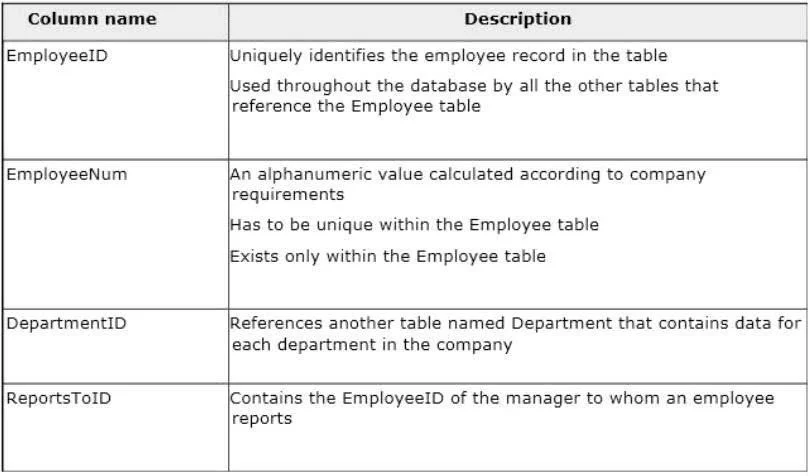
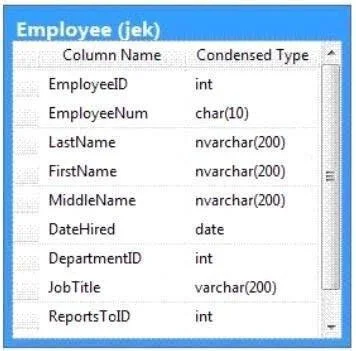
You administer a Microsoft SQL Server 2012 database. The database contains a table named Employee. Part of the Employee table is shown in the exhibit. (Click the Exhibit button.) Confidential…
The correct answer is C. EmployeeID. An IDENTITY specification auto-generates sequential numeric values and is used on surrogate primary key columns. EmployeeID is the primary key of the Employee table - the system-generated identifier that uniquely identifies each row. A seed of 1,000 means the first inserted row…
Question
You administer a Microsoft SQL Server 2012 database. The database contains a table named Employee. Part of the Employee table is shown in the exhibit. (Click the Exhibit button.) Confidential information about the employees is stored in a separate table named EmployeeData. One record exists within EmployeeData for each record in the Employee table. You need to assign the appropriate constraints and table properties to ensure data integrity and visibility. On which column in the Employee table should you use an identity specification to include a seed of 1,000 and an increment of 1?
Exhibits
Options
- ADateHired
- BDepartmentID
- CEmployeeID
- DEmployeeNum
- EFirstName
- FJobTitle
- GLastName
- HMiddleName
- IReportsToID
How the community answered
(31 responses)- C90% (28)
- F6% (2)
- I3% (1)
Explanation
An IDENTITY specification auto-generates sequential numeric values and is used on surrogate primary key columns. EmployeeID is the primary key of the Employee table - the system-generated identifier that uniquely identifies each row. A seed of 1,000 means the first inserted row receives the value 1,000, and an increment of 1 means each subsequent row increases by 1. The other columns are disqualified for identity: DateHired is a date type, FirstName/LastName/MiddleName/JobTitle are strings, DepartmentID and ReportsToID are foreign keys pointing to other tables, and EmployeeNum is typically a business-assigned identifier - none of these should be auto-incremented system keys.
Topics
Community Discussion
No community discussion yet for this question.