
70-450 · Question #94
You administer a SQL Server 2008 instance that hosts a large database. The following backup strategy is used for the database: - A full database backup is performed at 02:00 hr every Monday. - A…
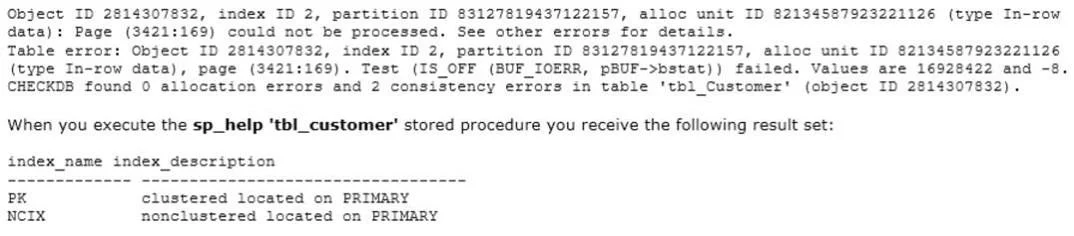
The correct answer is B. Drop and recreate the NCIX index. The error refers to index 2. Since the clustered index on a table is always index 1, this means there's a problem with the nonclustered index. Dropping and recreating this may fix the seek issue quickly as indicated in the requirements. In situations such as this, it's always a…
Question
You administer a SQL Server 2008 instance that hosts a large database. The following backup strategy is used for the database:
- A full database backup is performed at 02:00 hr every Monday.
- A differential backup is performed at 23:00 hr every day.
- A transaction log backup is performed on an hourly basis.
- A power failure on Thursday causes the SQL Server 2008 server to
restart at 09:15 hr. Fifteen minutes after the server restarts, the users report that they are unable to execute certain queries that access customer data. You discover that the customer data is unmodified after the power failure. When you execute the DBCC CHECKDB command on the database, you receive the following error message:
You need to ensure that the data is available as quickly as possible with minimal effect on users. What should you do?
Exhibit
Options
- ADrop and recreate the PK index.
- BDrop and recreate the NCIX index.
- CRestore the latest full database backup.
- DRestore the latest full database backup.
How the community answered
(28 responses)- A4% (1)
- B86% (24)
- C7% (2)
- D4% (1)
Explanation
The error refers to index 2. Since the clustered index on a table is always index 1, this means there's a problem with the nonclustered index. Dropping and recreating this may fix the seek issue quickly as indicated in the requirements. In situations such as this, it's always a better idea to restore from backups. There's no way of telling how bad the damage is. However, to get the database running as quickly as possible, D) is the immediate solution. Any steps taken after that aren't relevant.
Topics
Community Discussion
No community discussion yet for this question.