
70-450 · Question #108
You administer four SQL Server 2008 instances. Each instance hosts a single database application. You plan to migrate all four instances to a new SQL Server failover cluster. The four instances are…
The correct answer is C. Two-node active/passive cluster that has each node containing a minimum of 18 processors. Clustering provides protection against server hardware failure by using multiple systems (nodes) that share a disk array. It does NOT protect against that disk array failing. Active/Passive means that one node is hosting the SQL Server instance, while the other is sitting…
Question
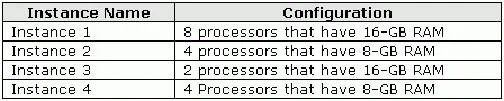
You administer four SQL Server 2008 instances. Each instance hosts a single database application. You plan to migrate all four instances to a new SQL Server failover cluster. The four instances are configured as shown in the following table. The four instances are fully optimized and have no spare CPU cycles or extra memory. The new cluster will host all four databases on a single virtual cluster IP address. You need to ensure that the new cluster is configured to handle the workload of all the database applications by using the minimum amount of hardware resources. Which cluster configuration should you use?
Exhibit
Options
- AFour-node active/active/active/active cluster that has each node containing a minimum of 9
- BTwo-node active/active cluster that has each node containing a minimum of 9 processors
- CTwo-node active/passive cluster that has each node containing a minimum of 18 processors
- DFour-node active/active/active/passive cluster that has each node containing a minimum of
How the community answered
(43 responses)- A5% (2)
- B5% (2)
- C74% (32)
- D16% (7)
Explanation
Clustering provides protection against server hardware failure by using multiple systems (nodes) that share a disk array. It does NOT protect against that disk array failing. Active/Passive means that one node is hosting the SQL Server instance, while the other is sitting around waiting for the first one to fail. It's the preferred solution, but means that both nodes have to be powerful enough to host the entire SQL server instance. Two-node implementations are the most common and least expensive. More nodes can be added to distribute the load. Since a requirement mentioned is to minimize hardware usage, a two-node option is preferable. Active/Passive is generally recommended by Microsoft as well. Also, the question states that each instance is currently EXACTLY powerful enough to perform its duties without any overhead. This would make splitting the hardware into two active nodes impossible, as the values for processor and RAM don't add up neatly enough to split the instances 50/50 based on existing Required reading: Start at SQL-Server-Performance, move on to MSSQLTips, finish with the white paper (PDF). nload.microsoft.com%2Fdownload%2F6%2F9%2FD%2F69D1FEA7-5B42-437A-B3BA- A4AD13E34EF6%2FSQLServer2008FailoverCluster.docx&rct=j&q=sql%20server%202008%20cl uster%20microsoft%20white% 20paper&ei=7T2rTOG8EcWBlAfN8fnEDA&usg=AFQjCNGI1hQIgs4JkiNAfD6zVvVl1-
Topics
Community Discussion
No community discussion yet for this question.