
70-332 · Question #56
You need to meet the site availability requirements. What should you do?
The correct answer is A. Configure each web server as a node of a Network Load Balancing (NLB) cluster. Network Load Balancing (NLB) meets site availability requirements by distributing requests across multiple web front-end servers and providing automatic failover.
Question
Exhibit
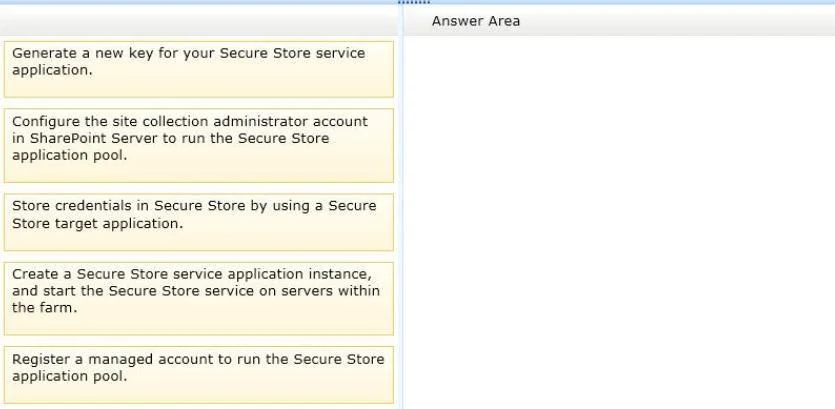
Options
- AConfigure each web server as a node of a Network Load Balancing (NLB) cluster.
- BCreate an alternate access mapping entry for each server.
- CCreate client-side host entries to point to specific servers.
- DCreate Request Management rules to route traffic to each server.
How the community answered
(50 responses)- A78% (39)
- B4% (2)
- C12% (6)
- D6% (3)
Why each option
Network Load Balancing (NLB) meets site availability requirements by distributing requests across multiple web front-end servers and providing automatic failover.
Configuring each SharePoint web server as a node in an NLB cluster distributes incoming HTTP and HTTPS traffic evenly across all nodes, preventing any single server from being a point of failure. If one node becomes unavailable, NLB automatically redirects all traffic to the remaining healthy nodes without manual intervention. This combination of load distribution and failover capability directly satisfies high availability requirements.
Alternate access mappings map public URLs to web application internal URLs but do not distribute load between servers or provide failover if a server goes offline.
Client-side host entries point clients to specific servers by hostname, providing no automatic load distribution or failover when a targeted server fails.
Request Management rules in SharePoint handle throttling and request prioritization but do not replace the network-level redundancy that NLB provides.
Concept tested: SharePoint high availability with NLB clustering
Source: https://learn.microsoft.com/en-us/sharepoint/administration/plan-for-internet-intranet-and-extranet-publishing
Topics
Community Discussion
No community discussion yet for this question.