
70-158 · Question #54
You deploy Forefront Identity Manager (FIM) in your company network to synchronize user accounts between Active Directory and an HR application. End users use the FIM Self-Service Portal to reset…
Sign in or unlock 70-158 to reveal the answer and full explanation for question #54. The question stem and answer options stay visible for context.
Submitted by yousef_jo· Mar 4, 2026Deploy Forefront Identity Manager
Question
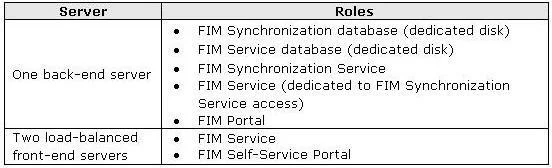
You deploy Forefront Identity Manager (FIM) in your company network to synchronize user accounts between Active Directory and an HR application. End users use the FIM Self-Service Portal to reset passwords and manage groups. You use a two-tiered architecture according to the following table Currently, the number of users and groups has doubled. You experience delays in performance of the Active Directory Management Agent (AD MA). You need to improve the performance of the MA . What should you do?
Exhibit
Options
- AConfigure the AD MA to run as a different service account.
- BAdd an additional front-end server to the two load-balanced front-end servers.
- CSplit the FIM Synchronization Service, and then install it on a new separate physical server.
- DSplit the FIM Portal from the back end, and then install it on a new separate physical server.
Unlock 70-158 to see the answer
You've previewed enough free 70-158 questions. Unlock 70-158 for full answers, explanations, the timed quiz mode, progress tracking, and the master PDF. Question stem and options stay visible so you can still see what's on the exam.
Topics
#FIM Synchronization Service#AD MA#Performance Optimization#FIM Architecture