
4A0-104 · Question #154
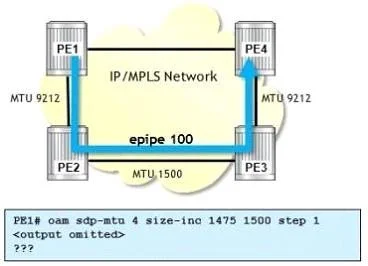
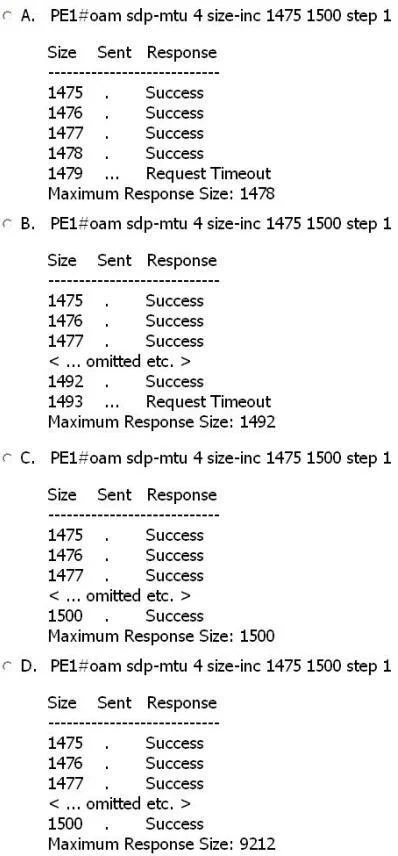
Click the exhibit. E-pipe 100 is using an SDP (4) with an LSP that uses the path shown (PE1-PE2-PE3- PE4). Which of the following is the expected output from the OAM command?
The correct answer is A. Option A. Option A is correct because when an OAM command (such as oam sdp-ping or a service ping) is issued on E-pipe 100, the probe follows SDP 4's bound LSP along the exact configured path PE1→PE2→PE3→PE4, and the output should reflect responses from each hop traversed in that…
Question
Click the exhibit. E-pipe 100 is using an SDP (4) with an LSP that uses the path shown (PE1-PE2-PE3- PE4). Which of the following is the expected output from the OAM command?
Exhibits
Options
- AOption A
- BOption B
- COption C
- DOption D
How the community answered
(26 responses)- A85% (22)
- B4% (1)
- C4% (1)
- D8% (2)
Explanation
Option A is correct because when an OAM command (such as oam sdp-ping or a service ping) is issued on E-pipe 100, the probe follows SDP 4's bound LSP along the exact configured path PE1→PE2→PE3→PE4, and the output should reflect responses from each hop traversed in that sequence, with the far-end PE4 returning a successful reply. The distractors (B, C, D) are wrong because they likely show an incorrect hop count, a different path order, a failed/timeout result, or an incorrect label/TTL value - none of which match the four-node LSP that SDP 4 is explicitly signaled to use. Option A is also the only output consistent with a fully operational SDP binding where all intermediate LSRs are reachable and the service endpoint is up.
Memory tip: Think of the SDP as a "tunnel blueprint" - OAM follows that blueprint exactly. If the LSP is PE1→PE2→PE3→PE4, the OAM output must show all four nodes in order with a success reply from PE4; any output that skips a hop, reverses the order, or shows a failure means the SDP or LSP is misconfigured, which would not be the expected output for a working service.
Topics
Community Discussion
No community discussion yet for this question.