
3V0-21.23 · Question #59
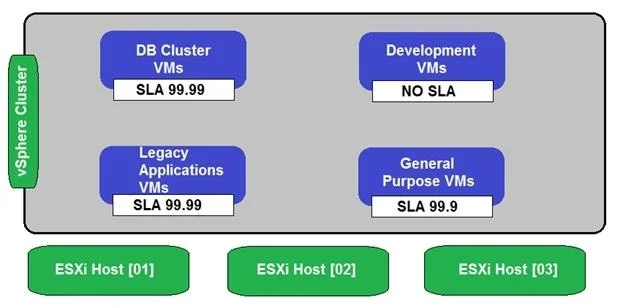
Refer to the exhibit. During a requirements gathering workshop, a customer shares the following diagram regarding their availability service-level agreements (SLAs): The customer states that there…
The correct answer is B. Enable Fault Tolerance. Fault Tolerance (FT) is correct because legacy applications with no built-in application-level availability need zero-downtime infrastructure protection. FT maintains a live secondary VM running in lockstep with the primary - if the primary host fails, the secondary takes over…
Question
Refer to the exhibit. During a requirements gathering workshop, a customer shares the following diagram regarding their availability service-level agreements (SLAs):
The customer states that there is no application level availability for legacy applications. Which recommendation could the architect make to meet the customer's high availability requirements for the legacy applications virtual machines?
Exhibit
Options
- AEnable vSphere HA and add a VM Override with VM Restart Priority set to Disabled
- BEnable Fault Tolerance
- CAchieve application availability with snapshots
- DEnable vSphere HA and add a VM Override with VM Restart Priority set to Lowest
How the community answered
(69 responses)- A6% (4)
- B81% (56)
- C10% (7)
- D3% (2)
Explanation
Fault Tolerance (FT) is correct because legacy applications with no built-in application-level availability need zero-downtime infrastructure protection. FT maintains a live secondary VM running in lockstep with the primary - if the primary host fails, the secondary takes over instantly with no restart, no data loss, and no application interruption, which is exactly what's needed when the app itself cannot recover or reconnect on its own.
Option A is wrong because setting the VM Override restart priority to Disabled actually tells vSphere HA to skip restarting that VM on host failure - this removes protection entirely rather than adding it. Option D is wrong because "Lowest" priority still relies on a VM restart, meaning the legacy application still experiences downtime (even if brief), which is unacceptable when there's no application-level mechanism to recover connections or state. Option C is wrong because snapshots are point-in-time backups used for recovery or testing - they provide no live failover capability and cannot prevent or minimize outages.
Memory tip: Think of it this way - vSphere HA restarts (downtime = seconds to minutes), while Fault Tolerance never stops (downtime = zero). Whenever an exam question mentions legacy apps with no application HA and strict availability SLAs, FT is the answer because it's the only VMware feature that delivers continuous availability at the infrastructure layer.
Topics
Community Discussion
No community discussion yet for this question.