
352-011 · Question #22
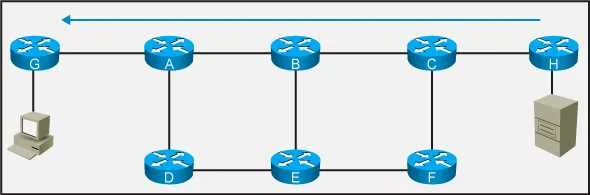
Refer to the exhibit. This network is running IS-IS as the single routing protocol and the LSP and SPF timers are aggressively configured so the network converges in subsecond. The customer reports…
The correct answer is E. Enable the advertisement of the overload bit for a specific amount of time after reload on router B. Enabling the overload bit on router B after reload prevents packet loss because it signals to all other IS-IS routers that B should not be used as a transit node until it has fully rebuilt its routing table and is stable - traffic will be rerouted around B during that recovery…
Question
Refer to the exhibit. This network is running IS-IS as the single routing protocol and the LSP and SPF timers are aggressively configured so the network converges in subsecond. The customer reports that router B had a memory crash and reloaded. Which resulted in some packets from the application being lost. The application servers are behind router G and the end users are behind router H, which design change should be made to prevent this packet-loss problem from reoccurring?
Exhibit
Options
- AUse asymmetric carrier delay timer
- BDeploy all links as point-to-point
- CRedesign the network as a flat level 2
- DOptimize the LSP/SPF timers to send LSPs immediately after a topology change
- EEnable the advertisement of the overload bit for a specific amount of time after reload on router B
How the community answered
(31 responses)- A10% (3)
- B6% (2)
- C16% (5)
- D3% (1)
- E65% (20)
Explanation
Enabling the overload bit on router B after reload prevents packet loss because it signals to all other IS-IS routers that B should not be used as a transit node until it has fully rebuilt its routing table and is stable - traffic will be rerouted around B during that recovery window, eliminating the blackhole period that caused the original packet loss.
Why the distractors are wrong:
- A (Asymmetric carrier delay): Carrier delay timers dampen link-flap events from being reported to the routing protocol. This is a link-stability tool, not a router-reload recovery mechanism.
- B (Point-to-point links): Changing link types removes the DIS election overhead but does nothing to prevent a reloading router from attracting traffic before it has a complete forwarding table.
- C (Flat Level 2): Flattening the IS-IS hierarchy simplifies routing policy but doesn't address the root cause - a reloading router accepting transit traffic prematurely.
- D (Optimize LSP/SPF timers): The question explicitly states timers are already aggressively tuned for subsecond convergence. The problem isn't convergence speed; it's that B re-advertises itself as a valid transit path before its RIB/FIB is fully populated.
Memory tip: Think of the overload bit as a "Back in 5 minutes" sign on a router - neighbors see it and route around the node until the sign comes down, protecting traffic during the router's startup window.
Topics
Community Discussion
No community discussion yet for this question.