
352-001 · Question #8
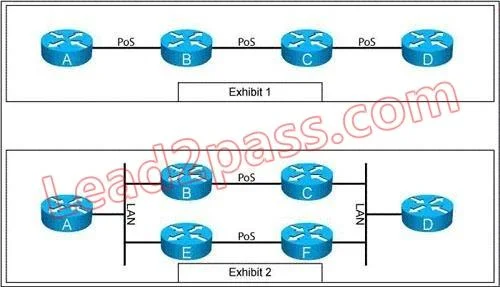
Refer to the exhibits. You have been asked to review a proposal for adding redundancy to the non-redundant network in Exhibit 1. Exhibit 2 shows the proposed redundant network. Which technology…
The correct answer is A. Bi-directional Forwarding Detection. BFD (Bidirectional Forwarding Detection) provides sub-second link failure detection - typically in tens of milliseconds - which is significantly faster than RSTP convergence times of 1-2 seconds.
Question
Refer to the exhibits. You have been asked to review a proposal for adding redundancy to the non-redundant network in Exhibit 1. Exhibit 2 shows the proposed redundant network. Which technology would provide faster convergence over the newly introduced layer 2 domains?
Exhibit
Options
- ABi-directional Forwarding Detection
- BRapid Spanning Tree
- CUnidirectional Link Detection
- DHot Standby Router Protocol
How the community answered
(28 responses)- A86% (24)
- B4% (1)
- C7% (2)
- D4% (1)
Why each option
BFD (Bidirectional Forwarding Detection) provides sub-second link failure detection - typically in tens of milliseconds - which is significantly faster than RSTP convergence times of 1-2 seconds.
BFD is a lightweight hello protocol that operates independently of routing or switching protocols and can detect link or path failures in as little as 50 milliseconds when configured with aggressive timers. It integrates with protocols like OSPF, BGP, and HSRP to trigger immediate failover, making it the fastest convergence mechanism listed. RSTP, by contrast, has a best-case convergence of approximately 1 second, making BFD the superior choice where rapid failover over newly introduced Layer 2 domains is required.
Rapid Spanning Tree Protocol (RSTP) improves on 802.1D STP but still has convergence times in the range of 1-2 seconds, which is orders of magnitude slower than BFD's sub-50ms detection capability.
Unidirectional Link Detection (UDLD) is designed to detect and disable one-way traffic links caused by physical layer problems, not to provide fast convergence or failover after a link failure.
Hot Standby Router Protocol (HSRP) is a first-hop redundancy protocol that operates at Layer 3 to provide default gateway redundancy, and while it can use BFD to speed up its own failover, it does not itself provide faster convergence over Layer 2 domains.
Concept tested: BFD for sub-second Layer 2 and Layer 3 convergence
Source: https://www.cisco.com/c/en/us/td/docs/ios-xml/ios/bfd/configuration/xe-16/bfd-xe-16-book/bfd-main-feature.html
Topics
Community Discussion
No community discussion yet for this question.