
352-001 · Question #790
Refer to the exhibit AJI links are P2P Layer 3 A high availability application is synchronizing data between host A and host B. To increase chance of delivery the same data is sent twice from host A…
The correct answer is C. IP Fast Reroute. IP Fast Reroute pre-computes loop-free alternate paths and activates them in sub-50 ms upon failure, ensuring the high-availability application does not lose in-flight packets during a topology change.
Question
Refer to the exhibit AJI links are P2P Layer 3 A high availability application is synchronizing data between host A and host B. To increase chance of delivery the same data is sent twice from host A on two different NICs toward the two NICs on host B. Which solution must be deployed in the network to ensure that any failure in the network does not trigger data loss on host B?
Exhibit
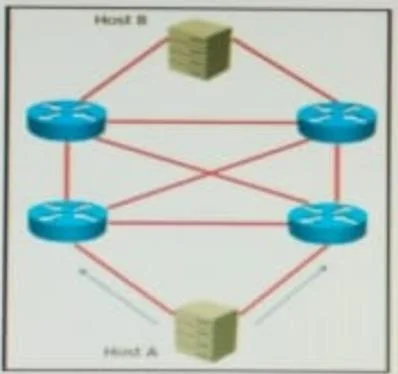
Options
- AEIGRP with feasible successors
- BBFD
- CIP Fast Reroute
- DStatic routes
How the community answered
(59 responses)- A5% (3)
- B19% (11)
- C64% (38)
- D12% (7)
Why each option
IP Fast Reroute pre-computes loop-free alternate paths and activates them in sub-50 ms upon failure, ensuring the high-availability application does not lose in-flight packets during a topology change.
EIGRP feasible successors provide rapid failover compared to other IGPs, but the failover still requires DUAL algorithm processing and can take tens to hundreds of milliseconds - long enough to drop packets for a real-time HA sync application.
BFD rapidly detects bidirectional forwarding failures and notifies the routing protocol, but BFD itself does not reroute traffic; it relies on the routing protocol to reconverge, introducing additional delay before alternate paths are used.
IP Fast Reroute (IPFRR) with Loop-Free Alternates (LFA) pre-installs backup next-hops in the FIB before any failure occurs. When a link or node failure is detected - typically via BFD or hardware signals - the router immediately switches to the pre-computed alternate path without waiting for routing protocol reconvergence. This sub-50 ms rerouting ensures that neither copy of the duplicated data stream is dropped, satisfying the zero-loss requirement of the HA synchronization application.
Static routes do not react automatically to link failures unless combined with object tracking and IP SLA, and even then the convergence time is too slow to prevent data loss in a real-time synchronization scenario.
Concept tested: IP Fast Reroute pre-computed LFA for sub-50ms failover
Source: https://www.cisco.com/c/en/us/td/docs/ios-xml/ios/iproute_osp/configuration/xe-16/iro-xe-16-book/iro-ip-frr-lfa.html
Topics
Community Discussion
No community discussion yet for this question.