
352-001 · Question #739
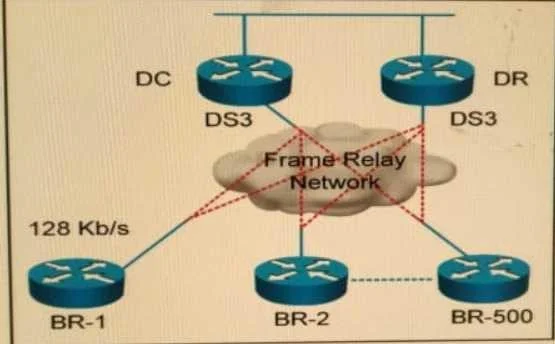
Refer to the exhibit. A retail company has around 500 branches across the U.S. The company is connected to the DC and DR routers through a Frame Relay cloud. All the communication happens only…
The correct answer is B. Provider backbone bridge. Provider Backbone Bridging (PBB/802.1ah) uses MAC-in-MAC encapsulation to minimize the provider core MAC table size, consuming the fewest provider resources for Layer 2 DC-to-DR connectivity.
Question
Refer to the exhibit. A retail company has around 500 branches across the U.S. The company is connected to the DC and DR routers through a Frame Relay cloud. All the communication happens only between BR routers to DC or DR routers, and there is no BR router to BR rotter communication. The service provider has decided to discontinue the Frame Relay service and replace it with Metro Ethernet. The retail company currently uses OSPF NBMA mode as IGP, which is the only scenario that the IT team is familiar with. The retail company decides to optimize the data center computing resources with server virtualisation. They have many serve, segments that need Layer 2 connectivity between the DC router and me DR router tor VM failover. Which Metro Ethernet technology uses a minimum of resources from the service provider network?
Exhibit
Options
- AEVPL
- BProvider backbone bridge
- CVPLS
- DQinQ
How the community answered
(49 responses)- A8% (4)
- B43% (21)
- C16% (8)
- D33% (16)
Why each option
Provider Backbone Bridging (PBB/802.1ah) uses MAC-in-MAC encapsulation to minimize the provider core MAC table size, consuming the fewest provider resources for Layer 2 DC-to-DR connectivity.
EVPL creates point-to-point or point-to-multipoint L2 circuits with per-EVC state that the provider must manage, consuming more resources than a backbone bridging approach.
PBB (IEEE 802.1ah) encapsulates customer Ethernet frames inside a provider Ethernet header with a separate provider MAC address space, so backbone switches only need to learn and maintain provider MAC addresses rather than every customer VM MAC address. This dramatically reduces MAC table size and flooding domain in the provider network, consuming the minimum provider resources. For the DC-to-DR Layer 2 VM failover requirement, PBB delivers the needed connectivity with the least overhead on provider infrastructure.
VPLS requires a full MPLS infrastructure with LDP or RSVP-TE signaling and a full mesh of pseudowires between PE routers, imposing significant provider resource consumption.
QinQ (802.1ad) double-tagging exposes all customer MAC addresses directly to the provider network, causing MAC table growth in provider bridges as the number of VMs scales up.
Concept tested: Provider Backbone Bridging MAC-in-MAC resource efficiency
Source: https://www.cisco.com/c/en/us/td/docs/routers/asr9000/software/asr9k_r5-1/lxvpn/configuration/guide/b_l2vpn51xasr9k_chapter_010.html
Topics
Community Discussion
No community discussion yet for this question.