
352-001 · Question #733
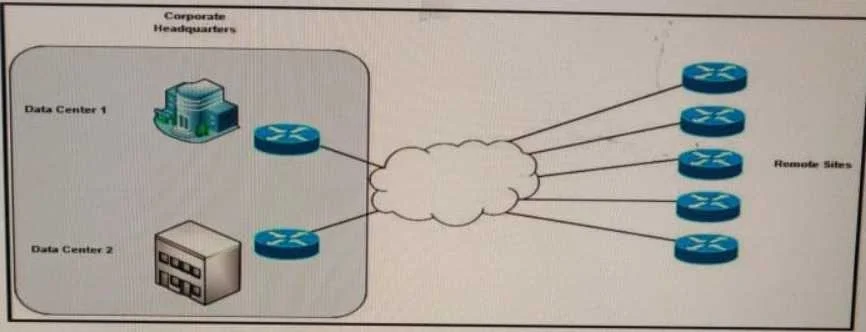
Refer to the exhibit. The company must connect five new remote sites to the network core of its corporate headquarters with path reliability. These remote sites run voice and data traffic. Two data…
The correct answer is A. Use PfR to dynamically change traffic flows tor forwarding frames and packets out of the remote C. Create an IPsec tunnel over a new point to point leased line directly from each remote site router. The question asks which two virtualized network solutions provide reliable connectivity for voice and data across five remote sites. PfR and IPsec tunnels over leased lines satisfy both the virtualization and path reliability requirements.
Question
Refer to the exhibit. The company must connect five new remote sites to the network core of its corporate headquarters with path reliability. These remote sites run voice and data traffic. Two data centers are in the core. Which two virtualized network solutions can achieve the required goal? (Choose two)
Exhibit
Options
- AUse PfR to dynamically change traffic flows tor forwarding frames and packets out of the remote
- BDeploy MPLS Layer 2 VPN to interconnect Itie two data centers the core to the remote sites
- CCreate an IPsec tunnel over a new point to point leased line directly from each remote site router
- DUse IPsec over GRE encapsulation with a DS3 line directly from each remote site router to the
- EDeploy MPI S Layer 3 VPN
How the community answered
(51 responses)- A55% (28)
- B6% (3)
- D14% (7)
- E25% (13)
Why each option
The question asks which two virtualized network solutions provide reliable connectivity for voice and data across five remote sites. PfR and IPsec tunnels over leased lines satisfy both the virtualization and path reliability requirements.
PfR (Performance Routing) dynamically monitors link performance metrics such as delay, jitter, and packet loss, then reroutes traffic to maintain path reliability for voice and data. It operates as a virtualized overlay intelligence layer that continuously optimizes forwarding decisions without requiring physical topology changes.
MPLS Layer 2 VPN is primarily designed to extend Layer 2 segments between data centers and does not provide path-reliable, dynamic WAN connectivity to multiple remote sites running mixed voice and data traffic.
Creating an IPsec tunnel over a point-to-point leased line from each remote site establishes a virtualized, encrypted WAN path with dedicated bandwidth, providing strong path reliability for voice and data. Unlike shared carrier services, a leased line ensures predictable latency and jitter characteristics essential for voice, while IPsec provides the virtualization layer for secure transport.
IPsec over GRE with a DS3 line adds GRE encapsulation overhead that can negatively impact voice quality and does not inherently provide dynamic path reliability or intelligent traffic rerouting.
MPLS Layer 3 VPN is a carrier-managed service that does not give the enterprise direct control over dynamic path reliability, making it unsuitable as a self-deployed virtualized solution for the described requirement.
Concept tested: Virtualized WAN path reliability solutions for remote sites
Source: https://www.cisco.com/c/en/us/td/docs/ios-xml/ios/pfr/configuration/15-mt/pfr-15-mt-book.html
Topics
Community Discussion
No community discussion yet for this question.