
352-001 · Question #697
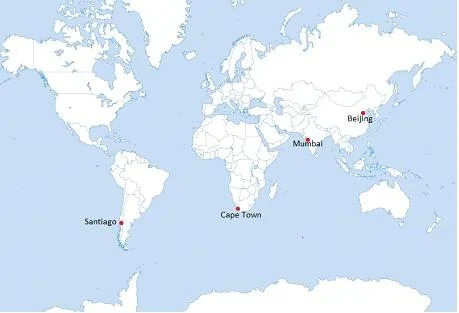
Refer to the exhibit. ACME Mining has four data centers in Santiago, Cape Town, Mumbai, and Beijing. They are full-mesh connected via a 400 Mb/s EVP-LAN. A 1-TB file transfer occurs daily via FTP…
The correct answer is B. Use TFTP instead of FTP. The root cause of the poor performance is the high round-trip time (RTT) of 378ms, not bandwidth - WAN utilization is only 20–30% and LAN under 5%, so bandwidth is not the bottleneck. FTP relies on TCP, and TCP throughput is fundamentally capped by the bandwidth-delay product…
Question
Refer to the exhibit. ACME Mining has four data centers in Santiago, Cape Town, Mumbai, and Beijing. They are full-mesh connected via a 400 Mb/s EVP-LAN. A 1-TB file transfer occurs daily via FTP between the Santiago and Mumbai data centers. When testing, this data transfer took an "unexpected and outrageous" 6 hours, with an average transfer rate of 47 KB/s. The network team provided this information:
- LAN bandwidth usage was below 5% at both data centers during transfer.
- WAN bandwidth usage was between 20-30% at both data centers during transfer.
- The only QoS on WAN is 200 Kb/s strict priority configured for other types of traffic.
- There is no QoS on LAN.
- The ping RTT average between data centers is 378 milliseconds.
Which action improves the file transfer rate?
Exhibit
Options
- AClassify the FTP transfer and use the strict priority queue on the WAN
- BUse TFTP instead of FTP
- CApply WAN optimization techniques at both data centers
- DUse SFTP instead of FTP
How the community answered
(41 responses)- A12% (5)
- B66% (27)
- C17% (7)
- D5% (2)
Explanation
The root cause of the poor performance is the high round-trip time (RTT) of 378ms, not bandwidth - WAN utilization is only 20–30% and LAN under 5%, so bandwidth is not the bottleneck. FTP relies on TCP, and TCP throughput is fundamentally capped by the bandwidth-delay product: Throughput ≈ TCP Window Size / RTT. With a default TCP window of 65,535 bytes and 378ms RTT, the theoretical maximum is roughly 174 KB/s, and with any packet loss or sub-optimal window sizing, 47 KB/s is plausible. TFTP uses UDP, which bypasses TCP's sliding window mechanism and congestion control entirely, removing the RTT-imposed ceiling on throughput. Option A is wrong because the WAN has unused capacity - strict priority won't fix a latency problem. Option C (WAN optimization) would also address the issue technically, but it requires deploying additional appliances at both sites, making it a heavier intervention. Option D (SFTP) still uses TCP over SSH and suffers the same RTT limitation.
Topics
Community Discussion
No community discussion yet for this question.